
SlideServe
Menu
Préférences
© SlideServe · v2026

Understanding Evolution by Natural Selection in Environmental Ecology

weylin avatar
22 diapositives · 409 Views · Oct 12, 2014

This course covers key concepts in ecology, emphasizing evolution by natural selection as a fundamental mechanism driving species diversity. Topics include the scientific method, hypothesis testing, and the historical context of ecology through figures like Darwin and Humboldt. Students explore ecosystem dynamics, optimal foraging theory, and the relationship between behavior and natural selection. A field trip is included, allowing hands-on experience. Key assignments focus on engaging with online resources and class participation.
Understanding Evolution by Natural Selection in Environmental Ecology - slide 1
01 / 22Understanding Evolution by Natural Selection in Environmental Ecology
1 / 17

Télécharger la présentation

Understanding Evolution by Natural Selection in Environmental Ecology
Une image / un lien ci-dessous est fourni (tel quel) pour télécharger la présentation

Politique de téléchargement : le contenu du site vous est fourni TEL QUEL pour votre information et votre usage personnel ; il ne peut être vendu, concédé sous licence ni partagé sur d’autres sites sans l’accord de son auteur.Le contenu vous est fourni TEL QUEL, pour votre information et votre usage personnel uniquement. Téléchargez la présentation en cliquant sur ce lien. Lors du téléchargement, si vous ne parvenez pas à télécharger une présentation, l’éditeur a peut-être supprimé le fichier de son serveur.Pendant le téléchargement, si vous ne parvenez pas à obtenir une présentation, le fichier a peut-être été supprimé par l’éditeur.

F I N

Plus de contenu associé

Transcription de la présentation
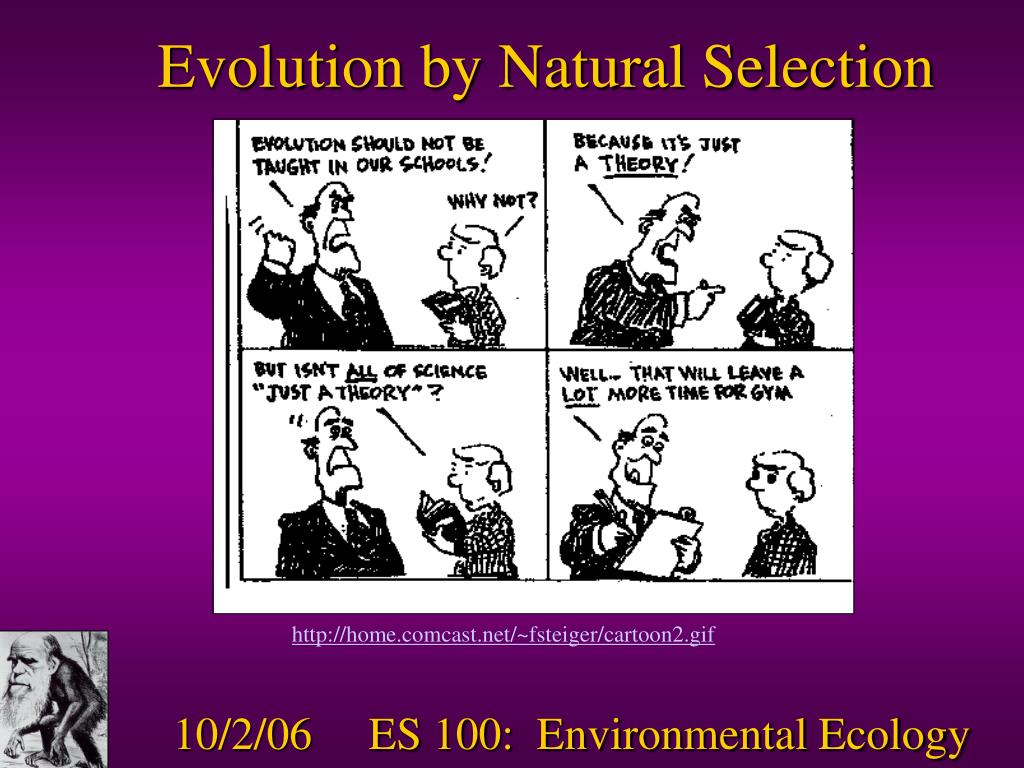
  1. Evolution by Natural Selection 10/2/06 ES 100: Environmental Ecology http://home.comcast.net/~fsteiger/cartoon2.gif

  2. A few more logistics… • From Eric Zimmerman: if you are a double major in ES and EEMB, you may not need to take this class. • Field Trip (Wed. before Thanksgiving) • Will take about 2 hours (8-9:50). • Transportation provided, but self-guided field exploration • You can do it BEFORE-hand, on your own, if you prefer • Midterm #2 (aka Final Exam) • Add codes: I actually have them now, come see me. • Section assignment this week: check course website!

  3. Recap of Intro. Lecture • Definition of ecology • Ecology vs. Environmentalism • Reductionism vs. Systems Thinking • Scientific Method: Case study of Lake Apopka Alligators • Hypotheses must be testable • A hypothesis can be disproved, yielding support for the ‘alternative’ hypothesis. • A theory is the highest level of scientific understanding

  4. Organization within Ecology Ecosystem Ecology  Community Ecology  Population Ecology  Physiological Ecology

  5. The Classification of Living Things Kingdom:Animalia Phylum:Chordata Class:Mammalia Order:Primata Family:Hominidae Genus:Homo Species:Sapiens

  6. Roots of Ecology • Carl von Linné (mid 1700’s) • classification of living things • Alexander von Humboldt (early 1800’s) • botanical geography • Charles Darwin and Alfred Wallace 1850 • animal geography • theory of evolution by natural selection • Ernst Haeckel 1866 • coined the term “ecology” • Edward Suess 1875 • “biosphere” as the condition that promotes life: it includes plants, animals, and non-living things • Arthur Tansley 1935 • “ecosystem” concept: interaction between living and non-living entities in the biosphere

  7. Theory of Evolution by Natural Selection • Natural selection is the mechanism that explains evolution • Natural Selection: scale = individual • Evolution: scale = many generations

  8. Temporal Scale

  9. Theory of Evolution by Natural Selection • Natural selection is the mechanism that explains evolution • Natural Selection: scale = individual • Evolution: scale = many generations • Darwin’s observations: • Organisms produce more young than can survive. • All species exhibit genetic variability (from mutation and random combination of parent’s genes). • Individuals with traits most suited to environment most likely to survive. • Only survivors contribute to the gene pool. • Theory: Lineages with most appropriate biological programming (genes) for current environmental conditions will leave the most descendants.

  10. Bush, page 7: “Sickle-cell anemia, Down’s syndrome, and color blindness are heritable, and each would reduce an individual’s chance of survival in a wild human population”

  11. When is Mutant Sickle-cell Gene Desirable? www.sicklecelldisease-il.org/.../ what/how.html

  12. Natural Selection and Physical Appearance

  13. Optimal Foraging Theory • Organisms that ‘forage’ most efficiently will be more likely to reproduce (improve fitness) • Thus, natural selection favors optimal foraging. • Cost/benefit analysis • What is foraging? • What do plants and animals forage for? police.ucsb.edu/ crime_prevent.html

  14. Experimental Evidence for Optimal Foraging Would ‘field’ observation match experimental results?

  15. Natural Selection and Biochemical Traits

  16. Testing Hypotheses:Observation vs. Experimentation • Experimentation: Manipulate system by creating experiments • Strength: control variables • Weakness: not realistic • Observation: • See patterns in the field • Strength: grounded in reality • Weakness: mechanistically weak

  17. Natural Selection and Behavior

  18. Are Human’s Exempt from Natural Selection? SWEATY T-SHIRT EXPERIMENT: http://www.pbs.org/wgbh/evolution/library/01/6/l_016_08.html

  19. Defining ‘evolution’ Scientific Definitions: • All the changes that have transformed life on earth from its earliest beginnings to the diversity that characterizes it today –Neil Campbell • The origination of species of animals and plants … –O.E.D. Common Usage: • A process of continuous change from a lower, simpler, or worse to a higher, more complex, or better state –Merriam-Webster’s Dictionary From a scientific point of view, evolution is just how new species come about

  20. Humans as an Evolutionary Endpoint?

  21. Theory of Evolution: Criticisms • Microevolution is generally accepted, but macroevolution is hotly debated • How does evolution add information to a genome to create progressively more complicated organisms? • How is evolution able to bring about drastic changes so quickly? • How could the first living cell arise spontaneously to get evolution started? Pakicetus Ambulocetus Basilosaurus Humpback

  22. Section this Week Internet assignment for section this week: • Visit course website • Follow “Evolutionary Feast” link • Prepare (typed) assignment and bring to section • Bring food to section (can bring a form of the fruit/vegetable- chocolate instead of cocoa beans)