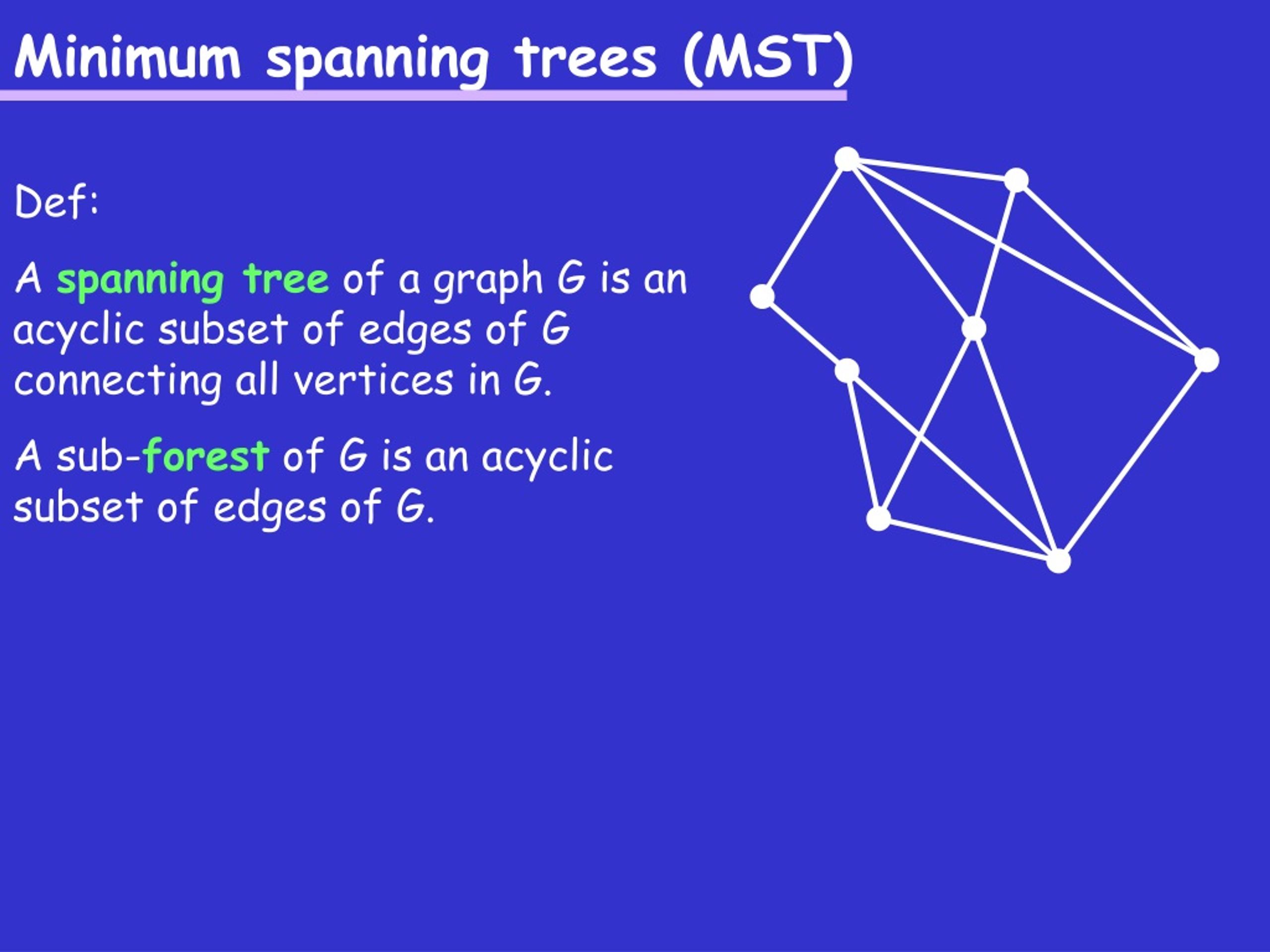
Minimum spanning trees (MST) Def: A spanning tree of a graph G is an acyclic subset of edges of G connecting all vertices in G. A sub-forest of G is an acyclic subset of edges of G.
Minimum spanning trees (MST) 1 Def: A spanning tree of a graph G is an acyclic subset of edges of G connecting all vertices in G. A sub-forest of G is an acyclic subset of edges of G. 15 7 8 4 3 5 7 2 1 1 6 2 Def: Given is a weighted (undirected) graph G=(V,E,w) where w:E->Reals defines a weight of every edge in E. A minimum spanning tree of G is a spanning tree with the minimum total weight of edges.
Minimum spanning trees (MST) - Kruskal 1 15 7 8 4 3 5 7 2 1 1 6 2 • Kruskal ( G=(V,E,w) ) • Let T=; • Sort the edges in increasing order of weight • 3. For edge e do • 4. If T [ e does not contain a cycle then • Add e to T • Return T
Minimum spanning trees (MST) - Kruskal 1 15 7 8 4 3 5 7 2 1 1 6 2 • Kruskal ( G=(V,E,w) ) • Let T=; • Sort the edges in increasing order of weight • 3. For edge e do • 4. If T [ e does not contain a cycle then • Add e to T • Return T
Minimum spanning trees (MST) - Kruskal 1 Lemma: Algo is correct. 15 7 8 4 3 5 7 2 1 1 6 2 • Kruskal ( G=(V,E,w) ) • Let T=; • Sort the edges in increasing order of weight • 3. For edge e do • 4. If T [ e does not contain a cycle then • Add e to T • Return T
Minimum spanning trees (MST) - Kruskal 1 Implementation? 15 7 8 4 3 5 7 2 1 1 6 2 • Kruskal ( G=(V,E,w) ) • Let T=; • Sort the edges in increasing order of weight • 3. For edge e do • 4. If T [ e does not contain a cycle then • Add e to T • Return T
Minimum spanning trees (MST) - Kruskal 1 Implementation? - Union-Find datastructure 15 7 8 4 • Init (V) • for every vertex v do • boss[v]=v • size[v]=1 • set[v]={v} • Union (u,v) • if size[boss[u]]>size[boss[v]] then • set[boss[u]]=set[boss[u]] union set[boss[v]] • size[boss[u]]+=size[boss[v]] • for every z in set[boss[v]] do • boss[z]=boss[u] • else do steps 2.-5. with u,v switched 3 5 7 2 1 1 6 2
Minimum spanning trees (MST) - Kruskal 1 Analysis of Union-Find 15 7 8 Lemma: n-1 Unions take O(n log n) time 4 3 5 7 2 1 1 6 2 • Union (u,v) • if size[boss[u]]>size[boss[v]] then • set[boss[u]]=set[boss[u]] union set[boss[v]] • size[boss[u]]+=size[boss[v]] • for every z in set[boss[v]] do • boss[z]=boss[u] • else do steps 2.-5. with u,v switched
Minimum spanning trees (MST) - Kruskal 1 Analysis of Union-Find 15 7 8 Lemma: k Unions take O(k log k) time 4 3 5 7 2 1 1 6 2 Corollary: The running time of Kruskal is: O(|E| log |E|) + O(|V| log |V|)
Minimum spanning trees (MST) - Prim 1 15 7 8 4 3 5 7 2 1 1 6 2
Minimum spanning trees (MST) - Prim 1 • Prim ( G=(V,E,w) ) • Let T=;, H=; • For every vertex v do • cost[v]=1, parent[v]=null • Let u be a vertex • Update (u) • 6. For i=1 to n-1 do • 7. u=vertex from H of • smallest cost (remove) • Add (u,parent[u]) to T • Update(u) • Return T 15 7 8 4 3 5 7 2 1 1 6 2 • Update (u) • For every neighbor v of u • If cost[v]>w(u,v) then • cost[v]=w(u,v), parent[v]=u • If v not in H then • Add v to H
Minimum spanning trees (MST) - Prim 1 Lemma: Prim is correct. 15 7 8 4 3 5 7 2 1 1 6 2 Running time:
Single source shortest paths - Dijkstra 1 Input: Output: G=(V,E,w) and a vertex s (w non-negative) shortest paths from s to every other vertex 15 7 8 4 3 5 7 2 1 1 6 Can use similar idea to Prim? 2
Single source shortest paths - Dijkstra 1 • Dijkstra ( G=(V,E,w), s ) • Let H=; • For every vertex v do • dist[v]=1 • dist[s]=0 • Update (s) • For i=1 to n-1 do • 7. u=extract vertex from H • of smallest cost • 8. Update(u) • Return dist[] 15 7 8 4 3 5 7 2 1 1 6 2 • Update (u) • For every neighbor v of u • If dist[v]>dist[u]+w(u,v) then • dist[v]=dist[u]+w(u,v) • If v not in H then • Add v to H
Single source shortest paths - Dijkstra 1 Lemma: Dijkstra is correct. 15 7 8 4 3 5 7 2 1 1 6 2 Running time:
All pairs shortest paths – Floyd-Warshall 1 Input: Output: G=(V,E,w), w non-negative shortest paths between all pairs of vertices 15 7 8 4 3 5 7 2 1 1 6 2
All pairs shortest paths – Floyd-Warshall 1 Input: Output: G=(V,E,w), w non-negative shortest paths between all pairs of vertices 15 7 8 4 3 5 7 2 1 1 6 • Idea 1: • Use Dijkstra from every vertex 2
All pairs shortest paths – Floyd-Warshall 1 Input: Output: G=(V,E,w), w non-negative shortest paths between all pairs of vertices 15 7 8 4 3 5 7 2 1 1 6 • Idea 1: • Use Dijkstra from every vertex • Idea 2: • How about dynamic programming? 2
All pairs shortest paths – Floyd-Warshall 1 Heart of the algorithm: 15 7 8 the length of the shortest path from i to j using only vertices · k 4 3 S[i,j,k] = 5 7 2 1 1 6 2
All pairs shortest paths – Floyd-Warshall 1 Heart of the algorithm: 15 7 8 the length of the shortest path from i to j using only vertices · k 4 3 S[i,j,k] = 5 7 2 1 1 6 2 How to compute S[i,j,k] ? S[i,j,k] =
All pairs shortest paths – Floyd-Warshall 1 • Floyd-Warshall ( G=(V,E,w) ) • For i=1 to |V| do • For j=1 to |V| do • S[i,j,0] = w(i,j) • For k=1 to |V| do • For i=1 to |V| do • For j=1 to |V| do • S[i,j,k] = min { • S[i,j,k-1], • S[i,k,k-1]+S[k,j,k-1] } • Return ? 15 7 8 4 3 5 7 2 1 1 6 2 w(i,j) if k = 0 min { S[i,j,k-1], S[i,k,k-1] + S[k,j,k-1] } if k > 0 S[i,j,k] =
Single source shortest paths – Bellman-Ford -1 • Input: • directed G=(V,E,w) and a vertex s • Output: • FALSE if exists reachable negative-weight cycle, • distance to every vertex, otherwise. 4 7 -7 4 3 5 -3 2 1 1 6 2
Single source shortest paths – Bellman-Ford -1 • Input: • directed G=(V,E,w) and a vertex s • Output: • FALSE if exists reachable negative-weight cycle, • distance to every vertex, otherwise. 4 7 -1 4 3 5 -3 2 1 1 6 2
Single source shortest paths – Bellman-Ford -1 4 7 -7 8 3 5 -3 • Bellman-Ford ( G=(V,E,w), s ) • For every vertex v • d[v] = 1 • d[s]=0 • For i=1 to |V|-1 do • For every edge (u,v) in E do • If d[v]>d[u]+w(u,v) then • d[v]=d[u]+w(u,v) • For every edge (u,v) in E do • If d[v]>d[u]+w(u,v) then • Return NEGATIVE CYCLE • Return d[] 2 1 1 6 2
Single source shortest paths – Bellman-Ford -1 Lemma: Bellman-Ford is correct. Running time: 4 7 -7 8 3 5 -3 • Bellman-Ford ( G=(V,E,w), s ) • For every vertex v • d[v] = 1 • d[s]=0 • For i=1 to |V|-1 do • For every edge (u,v) in E do • If d[v]>d[u]+w(u,v) then • d[v]=d[u]+w(u,v) • For every edge (u,v) in E do • If d[v]>d[u]+w(u,v) then • Return NEGATIVE CYCLE • Return d[] 2 1 1 6 2