
Understanding RSA Modular Division & Multiplicative Inverses
E N D
Presentation Transcript
RSA Public Key Encryption • To do RSA we need fast Modular Exponentiation and Primality generation which we have shown • We also need Modular Division • To do Modular Division we use the extended Euclid Algorithm which we will now build towards CS 312 - Modular Division and RSA
Euclid’s Rule for GCD • How do you find the greatest common divisor of two integers • Largest integer that divides both • Could factor but that is exponential • Back in ancient Greece Euclid discovered the rule: If x and y are positive integers with x ≥ y then gcd(x,y) = gcd(x mod y, y) • As soon as x mod y is 0, then y is the gcd • Must swap parameters each time to keep largest as 1st parameter CS 312 - Modular Division and RSA
Euclid’s Algorithm • This rule leads to the following algorithm Function Euclid (a,b) Input: Two integers a and b with ab 0 (n-bit integers) Output: gcd(a,b) if b=0: return a else: return Euclid(b, a mod b) • Examples • Complexity? CS 312 - Modular Division and RSA
Euclid’s Algorithm • This rule leads to the following algorithm Function Euclid (a,b) Input: Two integers a and b with ab 0 (n-bit integers) Output: gcd(a,b) if b=0: return a else: return Euclid(b, a mod b) • Examples • Complexity? • Each call reduces the arguments by at least 1/2 • Thus O(n =log2(a)) calls each with an n2 division • Complexity is O(n3) CS 312 - Modular Division and RSA
Extended Euclid’s Algorithm function extended-Euclid (a, b) Input: Two positive integers a and b with a b0 (n-bits) Output: Integers x, y, d such that d = gcd(a, b)and ax + by = d if b = 0: return (1, 0, a) (x', y', d) = extended-Euclid(b, a mod b) return (y', x' – floor(a/b)y', d) • Exact same as Euclid except during stack unraveling • This gives us the results we need for modular division • We'll do an example in a minute CS 312 - Modular Division and RSA
Modular Division - Multiplicative Inverses • Every real number a ≠ 0 has an inverse 1/a, (a·1/a = 1) • Dividing by a is the same as multiplying by the inverse 1/a • In modular arithmetic we say that x is the multiplicative inverse of a modulo N if ax = 1 (mod N) • Multiplicative inverse of 3 mod 5 = ? CS 312 - Modular Division and RSA
Modular Division - Multiplicative Inverses • Every real number a ≠ 0 has an inverse 1/a, (a·1/a = 1) • Dividing by a is the same as multiplying by the inverse 1/a • In modular arithmetic we say that x is the multiplicative inverse of a modulo N if ax = 1 (mod N) • Multiplicative inverse of 3 mod 5 = 2 • We will also call 2, a-1 mod N in this case • If a multiplicative inverse exists, it is unique mod N • Unlike regular arithmetic most numbers do not have a multiplicative inverse in modular arithmetic • What is the multiplicative inverse of 2 mod 4? • An Algorithm to find the inverse? CS 312 - Modular Division and RSA
Modular Division - Multiplicative Inverses • In fact, the only time a has a multiplicative inverse mod N is when a and N are relatively prime • Two numbers a and b are relatively prime if gcd(a,b) = 1 • If a and N are relatively prime then we know the multiplicative inverse exists (e.g. 4 mod 7) • We will use extended-Euclid(a,N) to find the multiplicative inverse x of a mod N • Must return 1 for the gcd to confirm that a and N are relatively prime • When a and N are relatively prime, the extended-Euclid algorithm returns x and y such that ax + Ny= 1 • Ny = 0 (mod N) for all integers y • Thus, ax 1 (mod N) • Then x is the multiplicative inverse of a modulo N • Modular N division can only be done for numbers relatively prime to N and the division is actually carried out by multiplying by the inverse CS 312 - Modular Division and RSA
Let's Try One • What is multiplicative inverse of 20 Mod 79 • Are they relatively prime? • Euclid or extended-Euclid are the algorithms we use to find out (with the extension not needed). The extension only kicks in after the gcd has been found anyway. • returns integers x, y, d such that d = gcd(a, b) and ax + by = d • Remember to put the largest number first and if you have to switch at the beginning, then remember to switch x and y at the end CS 312 - Modular Division and RSA
Multiplicative Inverse of 20 Mod 79 • function extended-Euclid (a, b) • if b = 0: return (1, 0, a) • (x', y', d) = extended-Euclid(b, a mod b) • return (y', x' – floor(a/b)y', d) CS 312 - Modular Division and RSA
Multiplicative Inverse of 20 Mod 79 • function extended-Euclid (a, b) • if b = 0: return (1, 0, a) • (x', y', d) = extended-Euclid(b, a mod b) • return (y', x' – floor(a/b)y', d) ax + Ny= 1 = 79(-1) + 20(4) ax + Ny= 1 = 20(4) + 79(-1) Since we switched initially switched 20 and 79 Thus x = a-1 = 4 Complexity? CS 312 - Modular Division and RSA
Multiplicative Inverse of 12 mod 15? • function extended-Euclid (a, b) • if b = 0: return (1, 0, a) • (x', y', d) = extended-Euclid(b, a mod b) • return (y', x' – floor(a/b)y', d) CS 312 - Modular Division and RSA
Multiplicative Inverse of 12 mod 15? • function extended-Euclid (a, b) • if b = 0: return (1, 0, a) • (x', y', d) = extended-Euclid(b, a mod b) • return (y', x' – floor(a/b)y', d) ax + Ny = 3 = 15(1) + 12(-1) However, there is no multiplicative inverse since the gcd = 3 and thus a and b are not relatively prime CS 312 - Modular Division and RSA
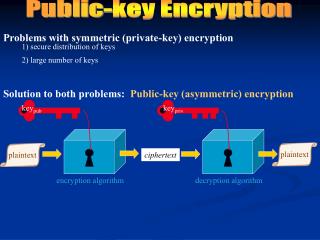
RSA • Now we have all the algorithms/tools needed to do RSA • RSA = Rivest, Shamir, and Adleman • Common Public Key Encryption Approach • Assume x is the initial message to be sent and e(x) encrypts x into y while d(y) decrypts y back to x • Private key approaches - Alice and Bob both know e and d and can thus communicate with each other – but new/unknown people can't • Public key - d is the inverse of e. Bob creates e and d and publishes e to everyone, but only he knows d. Alice can create her own pair and publish her own e, etc. Alice Bob e(x) = y d(y) = x encrypted y Eve CS 312 - Modular Division and RSA
RSA Encryption • Messages are numbers modulo N • Messages larger than N are segmented • Encryption is a bijection (one-to-one and onto) from {0, 1,..., N-1} to {0, 1,..., N-1} • a permutation • Decryption is its inverse CS 312 - Modular Division and RSA
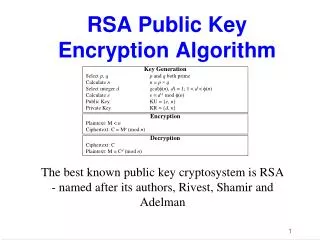
RSA Overview • Pick any two primes pand qand let N = p · q • Choose a number e relatively prime to (p-1)(q-1) • e is often chosen as 3 – permits fast encoding • Then the mapping xe mod N is a bijection onto {0, 1,..., N-1} - Publish (e, N) as the public key for encryption • Find d, the multiplicative inverse of e mod (p-1)(q-1) using extended-Euclid((p-1)(q-1), e) • Then for all x {0, 1,..., N-1} (xe)d = xmod N • Proof on p. 34 based on Fermat's if p is prime, then a p-1 1 mod p • Keep d private for decryption – Why can't they figure out d? CS 312 - Modular Division and RSA
Quick Example • Let p = 5; q = 11 • Then N = p·q = 55 • Let e = 3 • Note that gcd((p-1)(q-1),e) = gcd(40,3) = Euclid(40,3) = 1 • Thus, public key = (N, e) = (55, 3) • Private key: d = 3-1 mod 40 = 27 • found with extended-Euclid((p-1)(q-1),e) = extended-Euclid(40,3) which gives d = 27 • Encryption of x: y = x3 mod 55 • Encryption and decryption use modular exponentiation algorithm • Decryption of y: x = y27 mod 55 • Let x = 13 • y= 133= 52 (mod 55) • x = 5227 = 13 (mod 55) CS 312 - Modular Division and RSA
RSA Summary • How could we break RSA - Could try factoring N into primes p and q - no known polynomial algorithm • The crux of the security behind RSA • Efficient algorithms / Polynomial time computability for: • Modular Exponentiation – modexp() • GCD and modular division – extended-Euclid() • Primality Testing and creation – primality2() • Absence of sub-exponential algorithms for Factoring • The gulf between polynomial and exponential saves the day in this case CS 312 - Modular Division and RSA