Understanding China's Ethnic and Economic Cleavages: Dynamics of Citizens and State
This overview explores the complexities of China's societal cleavages, focusing on ethnic diversity and the rural-urban divide. With the Han Chinese constituting 92% of the population and 55 minority groups making up the remaining 8%, the state enforces policies that encourage economic development while suppressing dissent, particularly among minorities like Tibetans and Uyghurs. Economic growth has further deepened the divide, resulting in two distinct Chinas—urban and rural. Political participation is tightly controlled by the CCP, with limited avenues for citizen engagement despite the presence of multiple political parties and civil society organizations.

Understanding China's Ethnic and Economic Cleavages: Dynamics of Citizens and State
E N D
Presentation Transcript
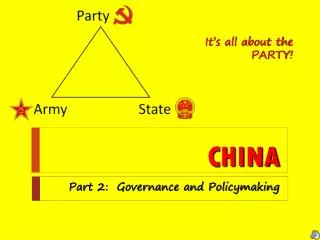
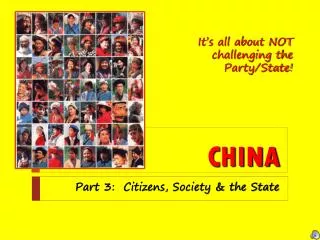
It’s all about NOT challenging the Party/State! CHINA Part 3: Citizens, Society & the State
Cleavages - Ethnic • Ethnic population is primarily Han Chinese (92%) • Minority ethnic groups = 8% of pop (abt 100 million citizens) • 55 officially recognized minority groups • Most live on/near borders with other countries • Most live autonomous regions • Govt policy: encourage economic development/suppress dissent • Tibetans/Dalai Lama • (see student presentation) • Uyghurs • Muslims of Turkish descent living in Xinjiang • Militants want separate Islamic state
Cleavages – Urban/Rural • Economic growth has led to “Two Chinas” • Urban (47% of pop, higher incomes, education, social class) • Rural (% declining) • Increasing inequality
Cleavages – Urban/Rural Facts • China only had 172 million urban residents in 1978 (when Deng Xiaoping started economic reform). By 2006, this number mushroomed to 577 million urbanites. • Between 1990 and 2005, an estimated 103 million Chinese people migrated from rural to urban areas. • By 2015, China’s urban population is expected to exceed 700 million…marking the first time China’s urban population will surpass its rural population. • In 2010, China’s rural per capita net income ($758 a year) was less than a third of its urban equivalent—the worst showing since China’s market reforms began in 1978 • Nearly 500 million Chinese people live on less than $2 a day. • 85% of China’s poor live in rural areas, with about 66% concentrated in the country’s west • Over half of China’s population lives in rural areas…but they share less than 12% of the country’s wealth. • China’s poverty among ethnic minorities is two to three times higher than among the Han Chinese • China currently has about 145 million migrant workers (or about 11 percent of China’s total population in 2010)…larger than the entire workforce of the United States. • 225 million rural-born migrant workers—one fifth of China’s population—work in urban areas but are denied benefits enjoyed by city dwellers, which has resulted in “a metastasizing underclass of rural migrants living as second-class citizens in China’s cities…the divide has sparked anger among the rural poor.”
Political Participation – Political Parties • CCP and Participation • Largest political party in world • Only 8% of citizens age 18+ are members • 2001 – capitalists allowed to become members • CCP’s Youth League • More than 75 million members • CCP allows existence of eight “democratic” parties • Each party has special group it draws from (intellectuals, etc) • Tightly controlled by CCP • Advisory role only
Political Participation – Elections • PRC holds elections to legitimize govt and CCP • Party controls the commissions that run elections and approves lists of candidates • Direct elections held at the local level only • Voters choose deputies to serve on county people’s congresses • Since 1980s CCP has allowed more than one candidate to run for county positions • Move toward democracy at village level • Local officials are no longer appointed from above, but are chosen in direct, secret ballot elections
Political Participation – Civil Society • Non-existent under Mao • Private organizations growing in recent years • Focus on social issues that do not directly challenge authority of state • 1990s NGOs could register with govt • China has thousands (ping pong clubs, environmentalist groups) • Christianity and Buddhism rebounding • Govt keeps close control on these groups • Esp Falun Gong (see student presentation)
Political Participation – Interest Groups & Social Control • Organized interest groups/social movements are not permitted unless under party-state authority • State corporatism • Party-state forms mass organizations • People express view within strict limits • Form around occupations and social categories • Urban areas party maintains social control through danwei • Social units based on person’s place of work