Cognitive Psychology
160 likes | 271 Vues
Dive into the intricate world of cognitive psychology, focusing on how attention directs information from sensory to working memory. Explore automaticity, the influence of various factors that attract attention such as size, intensity, and emotion. Learn why memory is essential, why we forget, and strategies to enhance memory through active learning. Discover effective techniques for optimizing memory retrieval, including the Levels of Processing model and seven crucial steps to master information retention. Join us in understanding how transfer affects learning success.


Cognitive Psychology
E N D
Presentation Transcript
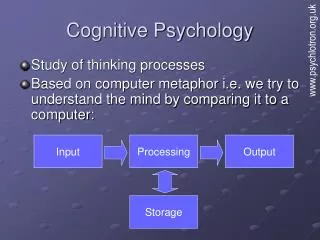
Cognitive Psychology Information Processing Model
Attention Directs information from what you perceive in sensory memory to working memory Misunderstood Minds activity, video http://www.pbs.org/wgbh/misunderstoodminds/attention.html
Automaticity With practice some processes that that originally occupy a high degree of attention eventually become automatic
What Attracts Attention • Size • Intensity • Novelty • Incongruity • Emotion • Personal Significance
Memory Why do we need memory?
Active Learning – Memory declarative knowledge procedural knowledge Conceptual knowledge conditional knowledge semantic memory
Many Memories • Sensory • Working • Long-term
Why do we forget? • http://www.youtube.com/watch?v=gZ5EhEYtdLg
Forgetting • Retrieval failure • Inability to locate material stored in long-term memory • Could be due to poor organization • Reconstruction error • Happens when students can only retrieve part of a memory and thus “fill in” the rest with information based on general knowledge and assumptions • Interference • Something the student already learned inhibits his/her ability to remember something else correctly • Decay • Information used infrequently difficult to retrieve • Failure to store • Student’s failure to use strategies that promote storage
Levels of Processing • How we process information impacts memory. • Surface processing, inattention – deep levels of processing (full cognitive engagement) • Example: Levels of Processing Activity
Conference • http://www.lds.org/move/index.html?type=conference&event=Oct179&lang=english • (6:14-8:17)
What’s the big deal about transfer? • + Transfer + • -- Transfer • NearTransfer • Far Transfer • Low-Road Transfer • High-Road Transfer
Elements that Promote Transfer • Transfer is a degree of mastery of the original subjects • Transfer is affected by the degree to which people learn with understanding rather than just memorizing facts • Be realistic about how much time it takes to learn • Motivation to Learn—spend more time learning
From Sensory to Long-Term Memory inSeven Steps 1.Reach2. Reflect3.Recode4. Reinforce5. Rehearse6. Review7. Retrieve By Marilee Sprenger
Factors that Influence Retrieval • How many “knowledge connections” are made • Whether the information has been learned to mastery • Learning to mastery helps students achieve automaticity • How frequently the knowledge is used • Whether there is a relevant retrieval cue