Stalemated 70s
Explore the complexities of the Stagflation era, the Supreme Court dynamics, Nixon's domestic policies, Watergate scandal, feminist victories and defeats, 1976 election, Carter's presidency, foreign policy, and economic challenges.

Stalemated 70s
E N D
Presentation Transcript
Stalemated 70s Chapter 39
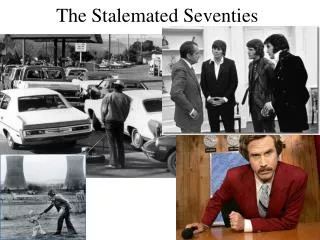
Stagflation • Causes : • More female and teen workers with less skills and less chance for wage advancement • Baby Boomers entering the work force, making jobs harder to find. • Aging of US factors and equipment • Competition from revitalized Europe and Japan start to dominate in Steel, electronics and automobiles, arenas that US had dominated.
Supreme Court • Supreme Court under fire from conservatives, and Nixon ran on the idea of appointing more conservative justices. • Warren Court handed down a number of cases regarding bill or rights that angered many conservative. • Griswold v. Connecticut. • Gideon v. Wainright • Miranda v. Arizona • New York Times v. Sullivan • Series of cases striking down school prayer and other religious activity in public schools.
Supreme Court • Nixon appoints four supreme court judges • Court grows more conservative, but still liberal overall. • Is Burger Court that decides Roe v. Wade in 1973 by a 7-2 margin.
Nixon the Progressive • Nixon had a liberal domestic agenda by today’s standards. • Expanded the benefits under Social Security • Indexed Social Security to inflation • Established the Environmental Protection • Clean Air Act and Endangered Species Act. • Rachel Carson—Silent Spring. Country had become sensitive to effects of pollution. • Crying Indian Ad
Nixon on Civil Rights • Philadelphia Plan: established affirmative action in federal contracting. • This was controversial, as it appeared to be reverse discrimination to some • Election strategy in 1972—Southern Strategy. • Led him to oppose mandatory school busing, call for more conservative judges and soft pedal on affirmative action
Nixon Landslide Of 1972 • Foreign Policy and Vietnam dominated the election. • Democrats nominated South Dakota Senator George McGovern. • Vietnam was front and center. Reason • McGovern ran an unabashedly liberal campaign. • He tried to appeal to minorities, feminists, leftists and youth. Reason didn’t work? • Eagleton Problem • Kissinger announcement • Nixon wins 49 states.
Watergate • Watergate break-in • CREEP and dirty tricks • Woodward and Bernstein • VP Agnew resigns for separate reasons • Gerald Ford appointed VP
Watergate • John Dean • Nixon Tapes • Saturday Night Massacre • Archibald Cox • US v. Nixon • Nixon Resigns, 8/8/1974
Gerald Ford • Inherited problems • Inherent problems • Nixon Pardon • Reasons • Political Cost • Helsinki Accords
Feminist Victories • Feminists had many victories in 60s and 70s. • 1972 Congress passes Title IX. • Congress passes the Equal Right Amendment, and many states ratify. • Supreme Court strikes down sex discrimination the Equal Protection clause and in employment under the Civil Rights Act of 1964. • Roe v. Wade in 1973 is seen as a victory for feminism. • Woman start entering professional schools and the workforce in more than subservient roles.
Feminist Defeats • Is a backlash against feminism. • Many conservatives and Christian conservatives argue that Men are supposed to be head of household and that children are harmed by mothers who work. • Phyllis Schally • Feminists are accused of wanting to be “manish”. • Increasing divorce rate is blamed on feminism. • ERA fails when enough states don’t ratify • ERA necessary? • Feminists ultimately victorious in next generation.
1976 Election • Gerald Ford wins the Republican nomination after a tough battle from Ronald Reagan. • Reagan philosophy. • Jimmy Carter wins Democratic nomination • Former governor of Georgia • Dark Horse. • Carter’s campaign themes • Outsider • Honest • Born-Again. • Carter wins a narrow victory with 51% of the vote.
Carter as President • Carter has the benefit of strong majorities in House and Senate, but governs ineffectively • Reasons. • Carter also inherits a number of problems. • Stagflation • High energy prices • Post Vietnam, post Watergate, post 1960s loss of faith and direction. • Carter establishes the Department of Energy • Gives amnesty to draft dodgers who had gone to Canada.
Carter’s Foreign Policy • Carter shifts focus of American Foreign policy to Human Rights and democracy. • Camp David Accords: Carter’s biggest foreign policy success is the Camp David Accords. • Egyptian President Anwar Sadat and Israeli President Menachem Begin. • Relations with China. • Panama Canal • Rational • Criticism
Economics and Malaise • Stagflation, continued to beset the country during the Carter presidency. • Inflation was well above 13% in 1979 • Causes • Impacts on economy • Carter seems impotent to deal with these problems • Malaise Speech
Foreign Frustrations • Cubans in Africa • Salt II • Criticism of Détente • Iranian Revolution • Shah of Iran • Attitude of revolutionaries toward U.S.
Hostage Crisis • Shah admitted to US for medical reasons • U.S. embassy seized and hostages taken • U.S. few good options • Failed rescue attempt • Impact on American psyche
Afghanistan • Soviet invasion of Afghanistan, December of 1979. • Soviets had long desired warm-water ports and greater influence over the Middle East and its oil. • Carter response • Carter threat • Olympic Boycott • Carter requires those over 18 to register for a draft, although no actual draft. • Afghanistan becomes the Soviet Viet Nam. • Long-term impact.