The Birthplace of Stars: Exploring the Interstellar Medium and Star Formation
330 likes | 456 Vues
The Interstellar Medium (ISM) may appear empty, yet it's rich with gas and dust, primarily hydrogen and helium, with an average density of 1 to 10 atoms/cm³. It plays a crucial role in star formation, where molecular clouds collapse under gravity, fueled by collisions and supernova shock waves. Within regions like the Orion Nebula and the Trifid Nebula, hot stars emit ultraviolet light, exciting surrounding gas and causing it to glow. The formation process includes protostars with accretion disks and the significant role of dust, influencing light scattering and leading to distinct reflection and emission nebulae.


The Birthplace of Stars: Exploring the Interstellar Medium and Star Formation
E N D
Presentation Transcript
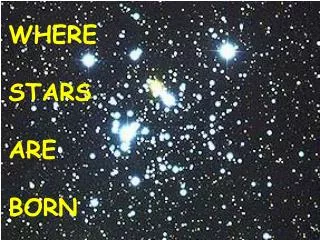
WHERE STARS ARE BORN
The Interstellar Medium (ISM) The space between the stars looks empty . . . But it’s not!
Gas Dust ~ 0.0001 cm * Mainly hydrogen + helium * Avg density 1 – 10 atoms/cm3 * 99% of ISM * Tiny grains (‘smoke’) * Silicates, carbon, ice (?) * Avg density 1 grain/million m3
‘Whirlpool’ Galaxy
Rosette Nebula Emission Nebulae * Ultraviolet photons from hot stars are absorbed by gas atoms – cause gas to glow.
Trifid Nebula North America Nebula
Hot Stars H atoms UV Earth
UV Hydrogen atom Electron ejected Electron recaptured Photon emitted
Red Balmer emission Line
Molecules – mainly hydrogen (H2). Carbon monoxide (CO) in Orion
Reflection Nebulae Pleiades Star Cluster * Glows due to scattered (reflected) starlight. * Dust scatters blue light more efficiently than red light.
Molecules abundant here Dark Nebulae
Emission nebula ‘Horsehead’ Nebula Reflection nebula
* Results from collapse of a molecular cloud. • Cloud collisions • Supernova blast wave • Expanding emission nebula • Galactic density wave
Molecular Cloud Shrink & heat Central temp 10 million K: Hydrogen fusion ignites ‘protostars’ (on main sequence)
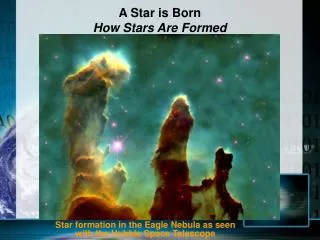
Star birth in the Eagle Nebula
Forming star? Star birth in the Trifid Nebula
* Accretion disk may form around young stars . . . Bipolar Flow
Bipolar Flow Disk p. 273
‘Evolutionary tracks’ on the HR diagram: Time required for contraction to main sequence depends on mass. pgs. 274-5
Protostar mass < 0.08 M: No hydrogen ignition: ‘Brown Dwarf’
The ‘Pistol’ Star M > 100 M Star disrupted by the pressure of photons.