Understanding Nonverbal Communication: The Key to Effective Interaction
This lecture by Asst. Prof. Dr. Emrah Görgülü explores the vital role of nonverbal communication in our interactions. While verbal communication utilizes language through speech and writing, nonverbal communication encompasses gestures, facial expressions, body language, and more. Understanding these nonverbal cues enhances our effectiveness in conveying messages and improves interpersonal relationships. The lecture covers body movement, time communication, touch, and the importance of aligning verbal and nonverbal signals. Gain insights into how to communicate effectively beyond words.

Understanding Nonverbal Communication: The Key to Effective Interaction
E N D
Presentation Transcript
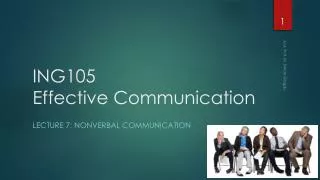
ING105 EffectiveCommunication Asst. Prof. Dr. Emrah Görgülü Lecture 7: Nonverbalcommunıcatıon
Verbal vs. NonverbalCommunication • Verbal communication is oftencalledlanguage. Inthat sense itrefers to the use of soundsandwordsto senda message. • It serves as a vehicle for expressing ourthoughts, ideas,desiresandotherthingswewanttogetacross. • Therearetwotypes of verbalcommunication: speechandwriting • A friendlychat • A phoneconversation • Writing a letter • A classdiscussion • How about a baby’scry? Whataboutgrunting?
Verbal vs. NonverbalCommunication (cont’d) • Nonverbal language is often definedas gestures and body language. It is any method of transferring information without words. • Facialexpressions, gestures, body languageandposture. • In addition to gestures and body language, sometimes what we donot say couldbe consideredto be nonverbalcommunication. • For instance, not answering a question could communicate severalthingssuch as: • not knowing the answer, • not having actually heard the questioner, • not worthy of answering.
A Joke a
Objectives Afterreadingthischapter, youshould be ableto • Explaintheconcept of body movement • Identifyuses of emblems, illustrators, affectdisplays, regulatorsandadaptors • Explaintheconcept of time communication • Explaintheconcept of smellcommunication • Explaintheconcept of touchcommunication • Define thetermparalanguage
NonverbalCommunication • Nonverbalcommunicationradiates (i.e. comes) fromall of thesenses but does not includetheuse of verbalsymbols. We can communicatethrough: • Sight (motion, colorandshape) • Artists communicatetheir ideas and feelings through colors and shapes. • Touch • Ahandshake, hug, a pat at the back • Smell • Yousmellsmokeandyoususpectifthere is fire somewhere • Sound • Youhear a bellringingandyouknowtheclass is over
NonverbalCommunication (cont’d) • Wesendmessagesthroughouruse of space, color, andtime; artifactssuch as furniture, clothingandjewelry. • Q: Why is nonverbalcommunicationimportant? A: A solidblend of verbalandnonverbalcommunicationskillsenhancesyoureffectivenesswithotherpeople. • It is importanttomakeadjustments in personalstyletomake sure ournonverbalmessagescomplementourverbalmessages.
NonverbalCommunication (cont’d) • Wecannot not communicate: Communicatorsassignmeaningtoallnonverbals. • Althoughyouhavenocontroloversomephysicalcharacteristicssuch as height, communicatorswillinterpretnonverbalmessagesfromphysicalcharacteristics. • Accordingto a University of Florida study: • Tallerpeopleearnmoremoney; supervisorsratedtallerstaffmembers as moreeffective.
NonverbalCommunication (cont’d) • It is importantforyoutoknowthatnonverbalsaccountfor a largeportion of our total communicationpackage. • Verbalcommunicationcomprisesonly 35% of our total communication. This is interestinglylessthanhalf. • Weusenonverbalsmuchmorethanverbals. • Youneedtomakecarefulchoicesaboutthenonverbalsthatyou can controlsothattheoverallimpression is consistentwithyourmessageandyourpersonalbrand.
FourFunctions of Nonverbals Therearefourbasicfunctions of nonverbalcommunication: • They can substitutefor a verbalmessage: It is far easiertopointtosomethingthantoexplainwhere it is. Inthiscasewechoose a nonverbalmessageratherthanwords. “Talk tothehand” It is a commonsubstitutionfor ______________
FourFunctions of Nonverbals (cont’d) • They can emphasize a verbalmessage: We can use a handgesturetomake a verbalstatementmoregrandiose. Sometimespeoplewanttoemphasize how bigsomething is by a handgesture. Itwas THIS BIG! Thedonationamountwas THIS SMALL!
FourFunctions of Nonverbals (cont’d) • They can contradict a verbalmessage: Wehaveto be careful of not contradictingourverbalswithournonverbals. Sometimes it is a nervousreactiontosmilewhenwetellveryseriousbadnews. • A person verbally expressing a statement of truth while simultaneously avoiding eye contact may convey a mixed message to the receiver.
FourFunctions of Nonverbals (cont’d) • They can regulateconversation: Weuseeyecontacttoletsomeoneknowwhen it is theirturnto talk orwe put up a handto stop someonefrominterrupting us. • Touchingsomeone's arm can signal that you want to talk next or interrupt. (do thehandout)
Types of NonverbalCommunication Thereare a number of types of nonverbalcommunication. • Body movement (Kinesics): Body movementgives a lot of informationaboutwhoweare. • Movements of the body, orsomepart of it, usedtocommunicate an idea, intentionorfeeling. • Eventhesmallestgestureormovementcommunicatesinformationabout us. • Eyecontact • Gestures • Facialexpressions • Headmovements (AmyCuddy’s video)
Types of NonverbalCommunication (cont’d) • Direct eyecontactwithotherpeople is expected in somecountries as a sign of respect but it is consideredto be aggressiveanddiscrespectful in others. • How about in Turkey? • Whatkind of body movements do youthinkareconsideredinappropriate? • Constant body motionshould be controlled • Shaking a footandtapping a penduringconversations • People mayinterpretthisbehavior as nervousnessor an indication of impatience.
Types of NonverbalCommunication (cont’d) Emblems • Emblems are nonverbalmovements which have a direct verbal translation, generally a word or phrase. • Theyaresubstitutionsforwordsandare often culture specific. They do not have a universalmeaning. • After an examyourfriendgivesyou a thumbs-up • The ‘V’ gesture • The ‘be quiet’ sign (watchtheclip!!)
Types of NonverbalCommunication (cont’d) Illustrators • Illustratorsarenonverbalsusedtoenhancetheunderstanding of a message. Theyaccompanyandliterallyillustratetheverbalmsg. • Saying ‘Let’sgo’ whilemotioningwithyourarmforyourfriendstogo • Saying ‘how big’ something is andopeningyourhands • We can pointtodirectattention of ourlisteners • Asking ‘what time is it?’ whilepointingtoyourwatch. • Be careful not tousetoomanyhandgestures. Inmanycultures, gesturingforeverycomment is distracting. (watchtheclip!!)
Types of NonverbalCommunication (cont’d) Affectdisplays • Affectdisplaysarefacialmusclemovementsusedtoconveymeaning. Affectdisplaysarefeelings expressed through our bodies. • Facialexpressionsrevealwhetherweare: • Happy • Sad • Angry • Interested • Surprised • Disgusted (watchtheclip!!)
Types of NonverbalCommunication (cont’d) Regulators • Regulatorsaremovementsthatdirecttheconversation. • Whentheinstructorasks a questionandyou do not wantto be called on, youlookdown at yourdesk. • Incontrast, thestudentwhomakeseyecontactwiththeinstructorsignals a desiretoanswerthequestion. • Regulatorsareactsthat help to initiate and terminate the speech of participants in a social situation. • Regulatorsmight suggest that the speakerwantstokeep talking, clarifysomething, or hurry up and finish. • Eyecontact is usedtolettheconversation partner knowwhethertokeeptalkingorwhen it is thelistener’sturntospeak. (watchthe video!!)
Types of NonverbalCommunication (cont’d) Adaptors • Adaptorsare self-touchingbehaviors. Adaptorsareofteninterpretedin a negativewaybyothercommunicators. • A personwho is alwaysfussingwithhair, glassesorclothing is perceivedto be nervousor not payingatttentiontowhat is beingcommunicated. • Adaptors areacts related to satisfying bodily needs. • Movinginto a more comfortable position, scratching