Enhancing Trust in Volunteer Distributed Computing Through Alternate Task Assignment Schemes
170 likes | 452 Vues
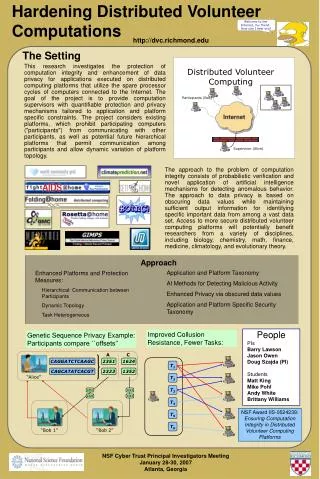
This paper presents a novel scheme for task assignment in volunteer distributed computing to enhance the system's efficacy and trust. The approach explores alternative methods such as vertical partitioning and clustering to mitigate issues like collusion among participants. By assigning redundant tasks and utilizing participant verification strategies, this scheme aims to improve adversary detection while minimizing computational burdens. Key applications include DNA sequence alignment and commercial uses, such as exhaustive regression and graphics rendering.


Enhancing Trust in Volunteer Distributed Computing Through Alternate Task Assignment Schemes
E N D
Presentation Transcript
An Alternate Multiplicity-2 Task Assignment Scheme for Distributed Computations D. Szajda, J. Owen, B. Lawson, A. Charlesworth University of Richmond Richmond, VA USA
Outline • Volunteer Distributed Computing • Simple Redundancy • Alternatives - Vertical Partitioning - Clustering • Analysis • Conclusions
I. Volunteer Distributed Computing • Organization of the distributed computation: - tasks - participants (anonymous) - supervisor • Examples: - SETI@Home, Folding@Home - DNA sequence alignment - commercial applications (exhaustive regression, graphics rendering, etc.)
When many PCs are involved… POWER! • Key idea: only significant results are returned to the supervisor • Issue addressed here: TRUST - Code executing in unknown environments - Significant results may be withheld - Cheating: credit for work not performed
II. Simple Redundancy • In an N-task computation, create identical copies and assign to 2N participants • Doubles the work required • Supervisor’s MO: if the two returned copies do not match, this signals a problem (check manually) if the two returned copies do match, it is usually assumed the work is correct
Biggest Weakness: Collusion • Many participants (and thus tasks) could be under control of a single individual - Results may be corrupted (either intentionally or unintentionally) - Significant results may be withheld
Example: Exhaustive Regression • One dependent/response variable (Y), five independent/predictor variables (X1, …, X5) Goal: find the “best” linear regression equation using any/all of the predictor variables Y = 0 + iXi + jXj + … 25 – 1 = 31 possible regression equations
Participant Assignments With 2N = 8 participants, we can divide the computation into N = 4 tasks: A, B, C, D Tasks collusion potential??
III. Alternative #1: Vertical Partitioning • Idea: spread the job of verifying the work of one participant to all other participants. Tasks Participant Assignments Subtasks
Advantages: Verifying a single task’s worth of work checks all N participants Exploits the finer task granularity and has improved control of result verification Identification of colluding parties / adversaries Drawbacks: Ability to subtask required Adversary with two tasks will always control a subtask Task assignment database management (prohibitive for large N)
Practical Vertical Partitioning: Clustering • Idea: break the computation into several clusters and apply the vertical partitioning strategy within each cluster Example: 4 tasks with 3 subtasks each, C = 2 clusters Participant Assignments
Advantages to the Clustering method: • An adversary who controls multiple participants is not guaranteed matching subtasks • Decreased task tracking overhead • Flexibility: designs can range from the two extreme cases of simple redundancy to vertical partitioning
IV. Analysis Suppose an adversary controls a certain proportion p of the 2N participants. For the three procedures, consider: • expected number of tasks/subtasks under her control? • variance? • probability of detecting the adversary if only a single task is verified?
Punch lines • Expected # of subtasks compromised: pN(2pN – 1) (for all schemes) • Variance of subtasks compromised: SR: VP: 0 • Probabilities are difficult but can be expressed
60 tasks, with C = 1 (VP), 3, 4, 6, 60 (SR) VP + C = 3 C = 4 C = 6 o SR
Conclusions • Presented a novel, tunable approach for applying redundancy in distributed computations • No additional computational burden • Improved detection of adversaries and collusion • Things get even better when ringers are employed
Questions? An Alternate Multiplicity-2 Task Assignment Scheme for Distributed Computations Jason Owen wowen@richmond.edu