Understanding Thunderstorms and Tornadoes: A Comprehensive Guide to Severe Weather
Explore the fascinating world of thunderstorms and tornadoes, learning about their formation, stages, and characteristics. From the life cycle of thunderstorms—cumulus stage, mature stage, and dissipating stage—to the formation of tornadoes associated with severe weather like supercells and squall lines. Understand the intensity and devastating effects of severe thunderstorms, including heavy rain, lightning, and hail. Gain insights into tornado forecasting, watches, and warnings issued by the National Weather Service, helping you recognize and prepare for these powerful natural phenomena.

Understanding Thunderstorms and Tornadoes: A Comprehensive Guide to Severe Weather
E N D
Presentation Transcript
Question of the Day • Where would you expect to find the greatest proportion of Tstorms and why?
Cyclone • Circulation around ANY low-pressure center • Intensity and size do not matter • Tornadoes and Hurricanes are smaller than mid-latitude cyclones and more violent
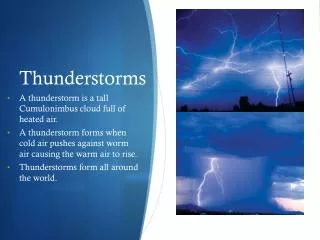
Thunderstorms • Storm that produces lightning and thunder • Characterized based upon the up/down draft of air NOT circular motion of air • Forms when warm, humid air rises in an unstable environment • Unequal heating of earth’s surface (Air-Mass Tstorms) • Unequal heating along with frontal wedging or oorgraphic lift (Severe Tstorms)
Air-Mass Thunderstorms • Occur in mT air that moves Northward from Gulf. • Most frequent during Spring and Summer • Frequently around midafternoon • Thunderstorm Project produced a model of the life cycle of a Tstorm • Cumuls Stage • Mature Stage • Dissipating Stage
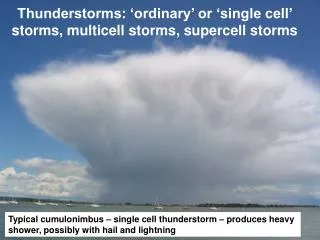
Cumulus Stage • Formation of cumulus clouds allow for moisture to be at greater heights • Clouds grow vertically • Cumulonimbus clouds form • Dominated by updraft • Downdraft forms and failing precipitation causes drag • Entrainment intensifies downdraft
Mature Stage • Officially starts when precipitation leaves the cloud • Updraft and downdraft exists side by side and grow the cloud • Anvil top forms when cloud reaches base of the stratosphere • Most active stage: Gusty winds, ligthning, hail/heavy precipitation
Dissipating Stage • Dominated by the downdraft • Cooler air aloft and falling precipitation causes cloud to evaporate
Severe Thunderstorms • Characterized by heavy downpours, flash flooding, strong/gusty winds, hail, lightning, and maybe tornadoes. • Must have winds over 58mph or hailstones .75 in diameter or produce a tornado
SupercellTstorms • Single, powerful cell up to 65,000’ and 12-30 miles in diameter • 2000-3000/year in the US • Can form mesocyclones when updraft rotates
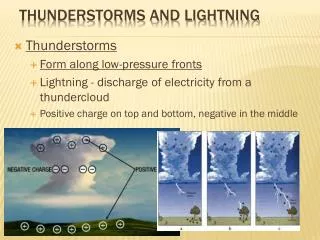
Thunder & Lightning • Thunder is: Expanding air • Heat Lightning • Lightning is created due to separation of charges in a cumulonimbus cloud • Sheet Lightning • Within the cloud or between clouds • 80% of all lightning • Cloud to Ground Lightning • 20% of lightning strokes • Most damaging and dangerous • Flash is made up of individual strokes • Leader, step leader, return stroke, and dart leader
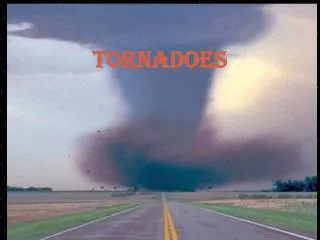
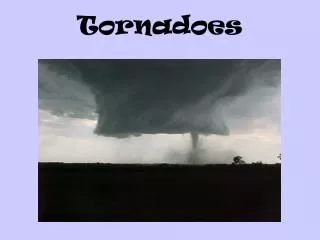
Tornadoes • AKA: twisters, cyclones • Violent windstorms that are a vortex • Contains lower pressure inside the vortex than the surrounding areas
Tornado Formation • Form in association with severe thunderstorms • Located wherever severe weather is: cold fronts, squall lines, hurricanes, supercells • Only tornado if funnel cloud touches surface
F-Scale • Fujita Intensity Scale • Determined based upon damage produced
Tornado Forecasting Watches Warnings • Alters public to POSSIBLITY of tornadoes over a specific area for a certain time period. • 65,000sq.km for 4-6 hours • Issued by local NWS • ACTUAL sighted tornado in an area or indicated by radar • Smaller areas and for shorter periods of time