Advanced Computer Architecture 5MD00
1.23k likes | 1.27k Vues
Discover various MIPS implementation approaches, pipeline hazards, RISC principles, memory organization, CPU registers, memory layout, and the machine language in advanced computer architecture using MIPS as an example.


Advanced Computer Architecture 5MD00
E N D
Presentation Transcript
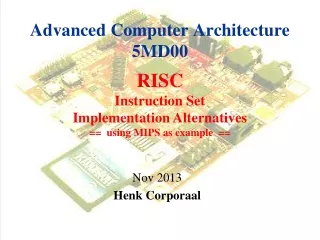
RISC Instruction Set Implementation Alternatives == using MIPS as example == Advanced Computer Architecture5MD00 Nov 2013 Henk Corporaal
Topics • MIPS ISA: Instruction Set Architecture • MIPS single cycle implementation • MIPS multi-cycle implementation • MIPS pipelined implementation • Pipeline hazards • Recap of RISC principles • Other architectures • Based on the book: Computer Organization and Designch2-4 (3rd , 4th or 5th ed) • Many slides; I'll go quick andskip some
Main Types of Instructions • Arithmetic • Integer • Floating Point • Memory access instructions • Load & Store • Control flow • Jump • Conditional Branch • Call & Return
MIPS arithmetic • Most instructions have 3 operands • Operand order is fixed (destination first)Example: C code: A = B + C MIPS code: add $s0, $s1, $s2 ($s0, $s1 and $s2 are associated with variables by compiler)
MIPS arithmetic C code: A = B + C + D; E = F - A; MIPS code: add $t0, $s1, $s2 add $s0, $t0, $s3 sub $s4, $s5, $s0 • Operands must be registers, only 32 registers provided • Design Principle: smaller is faster. Why?
Registers vs. Memory • Arithmetic instruction operands must be registers, — only 32 registers provided • Compiler associates variables with registers • What about programs with lots of variables ? Memory CPU register file IO
Register allocation • Compiler tries to keep as many variables in registers as possible • Some variables can not be allocated • large arrays (too few registers) • aliased variables (variables accessible through pointers in C) • dynamic allocated variables • heap • stack • Compiler may run out of registers => spilling
0 8 bits of data 1 8 bits of data 2 8 bits of data 3 8 bits of data 4 8 bits of data 5 8 bits of data 6 8 bits of data ... Memory Organization • Viewed as a large, single-dimension array, with an address • A memory address is an index into the array • "Byte addressing" means that successive addresses are one byte apart
0 32 bits of data 4 32 bits of data 8 32 bits of data 12 32 bits of data Memory Organization • Bytes are nice, but most data items use larger "words" • For MIPS, a word is 32 bits or 4 bytes. • 232 bytes with byte addresses from 0 to 232-1 • 230 words with byte addresses 0, 4, 8, ... 232-4 Registers hold 32 bits of data ...
Memory layout: Alignment 31 23 15 7 0 Words are aligned • What are the least 2 significant bits of a word address? 0 this word is aligned; the others are not! 4 8 12 address 16 20 24
Instructions: load and store Example: C code: A[8] = h + A[8]; MIPS code: lw $t0, 32($s3) add $t0, $s2, $t0 sw $t0, 32($s3) • Store word operation has no destination (reg) operand • Remember arithmetic operands are registers, not memory!
Let's translate some C-code • Can we figure out the code? swap(int v[], int k); { int temp; temp = v[k] v[k] = v[k+1]; v[k+1] = temp; } swap: muli $2 , $5, 4 add $2 , $4, $2 lw $15, 0($2) lw $16, 4($2) sw $16, 0($2) sw $15, 4($2) jr $31 Explanation: index k : $5 base address of v: $4 address of v[k] is $4 + 4.$5
op rs rt rd shamt funct 000000 10001 10010 01001 00000 100000 6 bits 5 bits 5 bits 5 bits 5 bits 6 bits Machine Language • Instructions, like registers and words of data, are also 32 bits long • Example: add $t0, $s1, $s2 • Registers have numbers: $t0=9, $s1=17, $s2=18 • Instruction Format: Can you guess what the field names stand for?
Machine Language • Consider the load-word and store-word instructions, • What would the regularity principle have us do? • New principle: Good design demands a compromise • Introduce a new type of instruction format • I-type for data transfer instructions • other format was R-type for register • Example: lw $t0, 32($s2) 35 18 9 32 op rs rt 16 bit number
Control flow • Decision making instructions • alter the control flow, • i.e., change the "next" instruction to be executed • MIPS conditional branch instructions:bne $t0, $t1, Label beq $t0, $t1, Label • Example: if (i==j) h = i + j;bne $s0, $s1, Label add $s3, $s0, $s1 Label: ....
Control flow • MIPS unconditional branch instructions: j label • Example:if (i!=j) beq $s4, $s5, Lab1 h=i+j; add $s3, $s4, $s5 else j Lab2 h=i-j; Lab1: sub $s3, $s4, $s5 Lab2: ... • Can you build a simple for loop?
op rs rt rd shamt funct op rs rt 16 bit address op 26 bit address So far: • InstructionMeaning add $s1,$s2,$s3 $s1 = $s2 + $s3sub $s1,$s2,$s3 $s1 = $s2 – $s3lw $s1,100($s2) $s1 = Memory[$s2+100] sw $s1,100($s2) Memory[$s2+100] = $s1bne $s4,$s5,L Next instr. is at Label if $s4 ° $s5beq $s4,$s5,L Next instr. is at Label if $s4 = $s5j Label Next instr. is at Label • Formats: R I J
Control Flow • We have: beq, bne, what about Branch-if-less-than? • New instruction:meaning: if $s1 < $s2 then $t0 = 1 slt $t0, $s1, $s2 else $t0 = 0 • Can use this instruction to build "blt $s1, $s2, Label" — can now build general control structures • Note that the assembler needs a register to do this, — use conventions for registers
Constants • Small constants are used quite frequently (50% of operands) e.g., A = A + 5; B = B + 1; C = C - 18; • Solutions? Why not? • put 'typical constants' in memory and load them • create hard-wired registers (like $zero) for constants like 0, 1, 2, … • or ……. • MIPS Instructions: addi $29, $29, 4 slti $8, $18, 10 andi $29, $29, 6 ori $29, $29, 4 3
filled with zeros 1010101010101010 0000000000000000 1010101010101010 0000000000000000 0000000000000000 1010101010101010 ori 1010101010101010 1010101010101010 How about larger constants? • We'd like to be able to load a 32 bit constant into a register • Must use two instructions; new "load upper immediate" instructionlui $t0, 1010101010101010 • Then must get the lower order bits right, i.e.,ori $t0, $t0, 1010101010101010
Assembly Language vs. Machine Language • Assembly provides convenient symbolic representation • much easier than writing down numbers • e.g., destination first • Machine language is the underlying reality • e.g., destination is no longer first • Assembly can provide 'pseudoinstructions' • e.g., “move $t0, $t1” exists only in Assembly • would be implemented using “add $t0,$t1,$zero” • Another pseudo instr: blt $t1, $t2, label • When considering performance you should count real instructions
Addresses in Branches and Jumps • Instructions: bne $t4,$t5,LabelNext instruction is at Label if $t4 $t5 beq $t4,$t5,LabelNext instruction is at Label if $t4 = $t5 j LabelNext instruction is at Label • Formats: • Addresses are not 32 bits — How do we handle this with load and store instructions? op rs rt 16 bit address I J op 26 bit address
What's the next address? • Instructions: bne $t4,$t5,LabelNext instruction is at Label if $t4 $t5 beq $t4,$t5,LabelNext instruction is at Label if $t4 = $t5 • Formats: • Could specify a register (like lw and sw) and add it to address • use Instruction Address Register (PC = program counter) • most branches are local (principle of locality) • Jump instructions just use high order bits of PC • address boundaries of 256 MB op rs rt 16 bit address I
MIPS Datapath • Building a datapath • support a subset of the MIPS-I instruction-set • A single cycle processor datapath • all instruction actions in one (long) cycle • A multi-cycle processor datapath • each instructions takes multiple (shorter) cycles • For details see book (ch 5, 3rd ed. Orch 4 in 4th ed. + app B):
Datapath and Control Registers & Memories FSM or Micro- programming Multiplexors Buses ALUs Control Datapath
The Processor: Datapath & Control • Simplified MIPS implementation to contain only: • memory-reference instructions: lw, sw • arithmetic-logical instructions: add, sub, and, or, slt • control flow instructions: beq, j • Generic Implementation: • use the program counter (PC) to supply instruction address • get the instruction from memory • read registers • use the instruction to decide exactly what to do • All instructions use the ALU after reading the registers Why? • memory-reference? • arithmetic? • control flow?
D a t a R e g i s t e r # A d d r e s s P C I n s t r u c t i o n R e g i s t e r s A L U A d d r e s s R e g i s t e r # I n s t r u c t i o n D a t a m e m o r y m e m o r y R e g i s t e r # D a t a More Implementation Details • Abstract / Simplified View: • Two types of functional units: • elements that operate on data values (combinational) • elements that contain state (sequential)
falling edge cycle time rising edge State Elements • Unclocked vs. Clocked • Clocks used in synchronous logic • when should an element that contains state be updated?
An unclocked state element • The set-reset (SR) latch • output depends on present inputs and also on past inputs R NOR Q NOR Q S R S Q 0 0 Q 0 1 1 1 0 0 1 1 ? Truth table: state change
Latches and Flip-flops • Output is equal to the stored value inside the element(don't need to ask for permission to look at the value) • Change of state (value) is based on the clock • Latches: whenever the inputs change, and the clock is asserted- level sensitive • Flip-flop: state changes only on a clock edge- edge-triggered A clocking methodology defines when signals can be read and written — wouldn't want to read a signal at the same time it was being written
D-latch (level-sensitive) • Two inputs: • the data value to be stored (D) • the clock signal (C) indicating when to read & store data (D) • Two outputs: • the value of the internal state (Q) and it's complement
D flip-flop (edge-triggered) • Output changes only on the clock edge D D Q D Q Q D D _ _ l a t c h l a t c h C C Q Q C
Our Implementation • An edge triggered methodology • Typical execution: • read contents of some state elements, • send values through some combinational logic, • write results to one or more state elements S t a t e S t a t e e l e m e n t C o m b i n a t i o n a l l o g i c e l e m e n t 1 2 C l o c k c y c l e
Read data 1 Read reg. #1 Read data 2 Read reg.#2 Write data Write reg.# Write Register File • 3-ported: one write, two read ports
R e a d r e g i s t e r n u m b e r 1 R e g i s t e r 0 R e g i s t e r 1 M u R e a d d a t a 1 x R e g i s t e r n – 1 R e g i s t e r n R e a d r e g i s t e r n u m b e r 2 M u R e a d d a t a 2 x Implementation of the read ports Register file: read ports • Register file built using D flip-flops
W r i t e C 0 R e g i s t e r 0 1 D n - t o - 1 C R e g i s t e r n u m b e r d e c o d e r R e g i s t e r 1 D n – 1 n C R e g i s t e r n – 1 D C R e g i s t e r n D R e g i s t e r d a t a Register file: write port • Note: we still use the real clock to determine when to write
P C S r c M A d d u x A L U A d d 4 r e s u l t S h i f t l e f t 2 R e g i s t e r s A L U o p e r a t i o n 3 R e a d M e m W r i t e A L U S r c R e a d r e g i s t e r 1 P C R e a d a d d r e s s R e a d M e m t o R e g d a t a 1 Z e r o r e g i s t e r 2 I n s t r u c t i o n A L U A L U R e a d W r i t e R e a d A d d r e s s r e s u l t M d a t a r e g i s t e r d a t a 2 M u I n s t r u c t i o n u x W r i t e m e m o r y D a t a x d a t a m e m o r y W r i t e R e g W r i t e d a t a 3 2 1 6 S i g n M e m R e a d e x t e n d Building the Datapath • Use multiplexors to stitch them together
Our Simple Control Structure • All of the logic is combinational • We wait for everything to settle down, and the right thing to be done • ALU might not produce “right answer” right away • we use write signals along with clock to determine when to write • Cycle time determined by length of the longest path S t a t e S t a t e e l e m e n t C o m b i n a t i o n a l l o g i c e l e m e n t 1 2 C l o c k c y c l e We are ignoring some details like setup and hold times !
Control • Selecting the operations to perform (ALU, read/write, etc.) • Controlling the flow of data (multiplexor inputs) • Information comes from the 32 bits of the instruction • Example:add $8, $17, $18 Instruction Format:000000 10001 10010 01000 00000 100000 op rs rt rd shamt funct • ALU's operation based on instruction type and function code
Control 2 00: lw, sw 01: beq 10: add, sub, and, or, slt 000: and 001: or 010: add 110: sub 111: set on less than Control 1 ALU Control: 2 level implementation bit 31 6 Opcode 2 26 ALUop instruction register 3 ALUcontrol 5 6 Funct. 0
0 M u x A L U A d d 1 r e s u l t A d d S h i f t l e f t 2 R e g D s t 4 B r a n c h M e m R e a d M e m t o R e g I n s t r u c t i o n [ 3 1 – 2 6 ] C o n t r o l A L U O p M e m W r i t e A L U S r c R e g W r i t e I n s t r u c t i o n [ 2 5 – 2 1 ] R e a d R e a d r e g i s t e r 1 P C R e a d a d d r e s s d a t a 1 I n s t r u c t i o n [ 2 0 – 1 6 ] R e a d Z e r o r e g i s t e r 2 I n s t r u c t i o n 0 R e g i s t e r s A L U R e a d A L U [ 3 1 – 0 ] 0 R e a d W r i t e M d a t a 2 A d d r e s s r e s u l t 1 d a t a I n s t r u c t i o n r e g i s t e r M u M u m e m o r y x u I n s t r u c t i o n [ 1 5 – 1 1 ] W r i t e x 1 D a t a x d a t a 1 m e m o r y 0 W r i t e d a t a 1 6 3 2 I n s t r u c t i o n [ 1 5 – 0 ] S i g n e x t e n d A L U c o n t r o l I n s t r u c t i o n [ 5 – 0 ] Datapath with Control
ALU Control1 • What should the ALU do with this instructionexample: lw $1, 100($2)35 2 1 100 op rsrt 16 bit offset • ALU control input000 AND 001 OR 010 add 110 subtract 111 set-on-less-than • Why is the code for subtract 110 and not 011?
ALU Operation class, computed from instruction type ALU Control1 • Must describe hardware to compute 3-bit ALU control input • given instruction type 00 = lw, sw 01 = beq, 10 = arithmetic • function code for arithmetic • Describe it using a truth table (can turn into gates): inputs outputs
ALU Control1 • Simple combinational logic (truth tables)
Deriving Control2 signals 9 control (output) signals Input 6-bits Determine these control signals directly from the opcodes:R-format: 0 lw: 35 sw: 43 beq: 4
Control 2 • PLA example implementation
P C S r c 1 M A d d u x A L U 0 4 A d d r e s u l t S h i f t R e g W r i t e l e f t 2 I n s t r u c t i o n [ 2 5 – 2 1 ] R e a d r e g i s t e r 1 R e a d M e m W r i t e R e a d P C d a t a 1 I n s t r u c t i o n [ 2 0 – 1 6 ] a d d r e s s R e a d M e m t o R e g A L U S r c r e g i s t e r 2 Z e r o I n s t r u c t i o n R e a d 1 A L U A L U [ 3 1 – 0 ] 1 R e a d W r i t e d a t a 2 1 A d d s s r e s u l t r e M r e g i s t e r M d a t a u I n s t r u c t i o n M u I n s t r u c t i o n [ 1 5 – 1 1 ] x W r i t e u x m e m o r y R e g i s t e r s x 0 d a t a 0 D a t a 0 W r i t e m e m o r y R e g D s t d a t a 1 6 3 2 S i g n I n s t r u c t i o n [ 1 5 – 0 ] e x t e n d A L U M e m R e a d c o n t r o l I n s t r u c t i o n [ 5 – 0 ] A L U O p Single Cycle Implementation • Calculate cycle time assuming negligible delays except: • memory (2ns), ALU and adders (2ns), register file access (1ns)