Earth Structure Notes
Discover the Earth's layers - Crust (oceanic and continental), Mantle (iron & magnesium composition), and Core (iron & nickel) - resembling an egg's shell, white, and yolk. Learn about lithosphere, asthenosphere, mesosphere, outer core, inner core, and tectonic plates. Explore the structure and properties of each layer in detail.

Earth Structure Notes
E N D
Presentation Transcript
Composition (What it is made of) • Crust • Mantle • Core
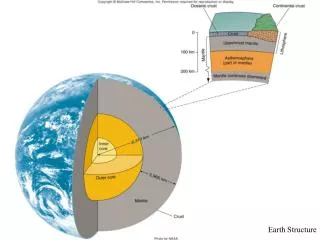
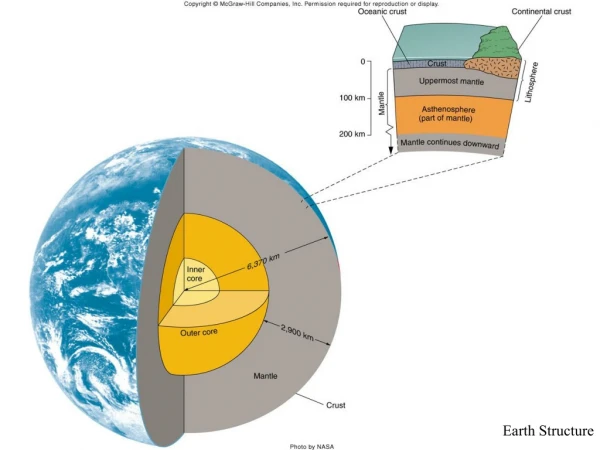
Outer layer 5 - 100 km thick (3 – 60 miles thick) Made of oxygen & silicon 2 types of crust Oceanic (very dense, made of basalt) Continental (less dense, made of granite) The Crust
Oceanic and Continental Crust • Oceanic crust 3 – 5 miles thick • Continental crust on average 18 miles thick
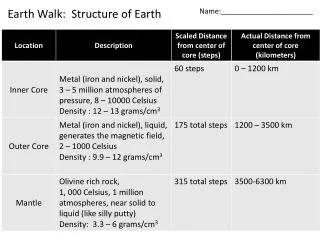
Middle layer Very thick layer Made of iron & magnesium 2,900 km thick Solid near core Upper part is semi-solid The Mantle
The Core • Made mostly of iron & some nickel • 1/3 of the earth’s mass • Very hot • 3,428 km thick
How are the earth’s layers similar to an egg? Shell=crust Egg white=mantle Yolk=core Earth’s Layers
Physical Structure of the Earth(5 Layers) • Lithosphere • Asthenosphere • Mesosphere • Outer Core • Inner Core (LAMOI)
The Lithosphere • Rigid outer layer (crust + top part of mantle) • Made of oxygen & silicon • Made of moving tectonic plates • 60 – 300 km thick
Tectonic Plates • Earth’s lithosphere is broken into about 19 pieces • These plates move on top of the asthenosphere
The Asthenosphere • Semi-solid; solid but flows like liquid, called PLASTICITY • Part of Mantle • Plates float on this layer; moved by convection currents • 250 km thick
The Mesosphere • Middle layer of Earth • Very strong solid layer • Lower part of mantle • 2,550 km thick
The Outer Core • Liquid layer • 4,000 – 5,000 Celsius • Made up of nickel & iron • 2,200 km thick
The Inner Core • Solid, very dense • 6,000 Celsius • Made up of iron • 1,228 km thick • Extreme pressure makes it solid even though it is still very hot