Understanding Essential Properties of Minerals: Composition, Hardness, and Identification
This guide explores key characteristics of minerals, including their definitions, chemical compositions, and physical properties such as color, streak, hardness, luster, cleavage, and fracture. Minerals are naturally occurring inorganic solids with crystalline structures. Learn how to identify minerals based on their properties, including the use of hardness tests and acid reactions, with examples like calcite and halite. Understand the importance of silicon and oxygen in the Earth's crust and discover practical applications, including the uses of talc and the differences between cleavage and fracture.

Understanding Essential Properties of Minerals: Composition, Hardness, and Identification
E N D
Presentation Transcript
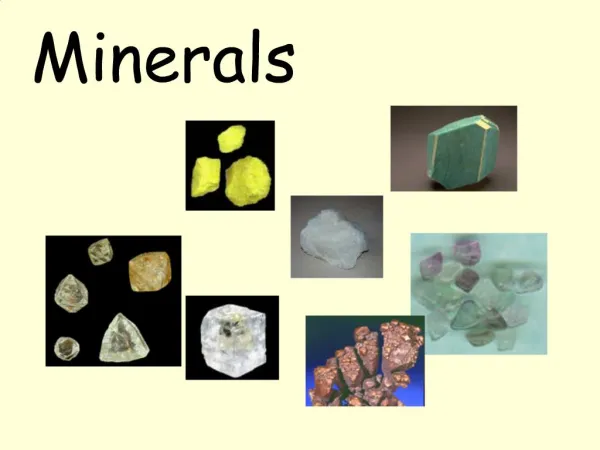
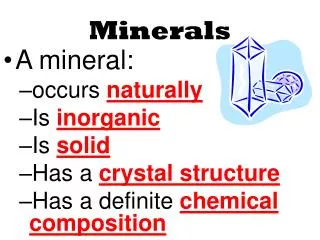
I. Minerals • A naturally occurring, inorganic, crystalline solid having a definite chemical composition.
A. Characteristics ESRT p.16 • Where can we find information to help us ID minerals? Back of the ESRT
A POOR way to identify a mineral. • Color: • Many different minerals have the same color. • The same mineral may have many different colors. Different Color Quartz Halite Calcite Quartz
The color of the powder of a mineral when it is crushed. • Streak:
The resistance of a mineral to being scratched. • Hardness: • The ‘streak’ of a mineral is not a hardness test, but minerals with a hardness of more than 7 will scratch the plate. • To find the hardness of a mineral you use objects of a known hardness to see if they will scratch the mineral.
The shine from a mineral’s Surface or the way a mineral looks in reflected light. • Luster:
The way a mineral will break along areas of weakness and form smooth parallel sides. • Cleavage:
The uneven breaking of a mineral because it doesn’t have specific weak areas. • Fracture:
Which shows Cleavage and which shows Fracture? Cleavage Fracture
Questions: • What is the hardness of Olivine? • Olivine’s hardness is 6.5 • How does Pyroxene break? • Cleaves in 2 directions at 90 degrees. • What is the chemical symbol for Sulfur? • Sulfur’s chemical symbol is “S”. • What is the Luster of Galena? • Galena has a Metallic Luster • What is Talc used for? • Talc is used in Talcum (baby) power.
Which mineral has a hardness of 2.5, is flexible in thin sheets, and is black in color? • Biotite Mica
B. Chemical Composition Silicon Oxygen • _______ and _______ are the two most abundant elements by mass in the Earth’s crust.
C. Mineral Structure Internally, minerals are made up of atoms arranged in a specific pattern. • This pattern will determine ALL of the physical and chemical properties of the mineral. • Over 90% of Earth’s minerals are ________. Silicates
D. Misc. Mineral Information • A “Carbonate” mineral reacts with ______________ and ‘bubbles’. Hydrochloric Acid
Carbon Lattice • Diamond and Graphite are both made of the same material, ______. • Diamonds are connected by a _______ network. • Graphite is set up in ______ and flakes off easily. • Diamond has a hardness of _____, while Graphite’s hardness is ______. Layers 10 1 -2
Physical Chemical • We identify minerals based on Two [2] Properties, they are: _______ and ________.
Questions • What is the difference between a Cleavage and Fracture? • Cleavage is the way a mineral breaks along a smooth, parallel sides, while Fracture is an uneven breaking. • What are the 2 ways that we classify a minerals Luster? • Metallic and Non-Metallic • How would you tell the difference between Calcite and Halite? • Calcite will react with HCl & Halite has cubic cleavage.
If a mineral can scratch a fingernail, penny, but NOT scratch an iron nail, its hardness must be • About 4. • What type of minerals will react or bubble when touched with acid and give an example of the specific mineral? • A carbonate mineral – Calcite (CaCO3)