Iterative decoding steps
This document explores the principles of iterative decoding and Likelihood Ratio (LLR) computations in Rayleigh fading channels. It discusses the performance impact of various factors, including block size, channel fading, and correlation. The significance of interleaver design is emphasized, particularly when channel state information (CSI) is not available for the decoder. Approximations using Gaussian distributions for estimating LLR are presented, along with methods for hard decision-making based on LLR after multiple iterations. Key findings reveal the complexities of channel measurements and their effects on decoding performance.

Iterative decoding steps
E N D
Presentation Transcript
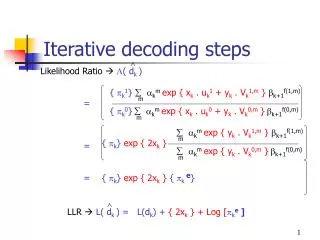
{ k1} km exp { xk . uk1 + yk . Vk1,m } k+1f(1,m) m { k0} km exp { xk . uk0 + yk . Vk0,m }k+1f(0,m) m km exp { yk . Vk1,m } k+1f(1,m) m { k} exp { 2xk } km exp { yk . Vk0,m }k+1f(0,m) m LLR L( dk ) = L(dk) + { 2xk } + Log [ke ] Iterative decoding steps Likelihood Ratio ( dk ) = = = { k} exp { 2xk } { k e}
ki,m = ke i exp { xk . uki + yk . Vki,m } km k1,m k+1f(1,m) km k0,m k+1f(0,m) m m Iterative decoding • For the second iteration; • Calculate LLR for all times Log Likelihood Ratio L( dk ) = Log • Hard decision based on LLR after multiple iterations
Channel measurement based LLR • When no CSI is available in the decoder, the equation can be approximated by a Gaussian distribution with a mean x·Ea [a]=0.8862 x , and a variance σ2. The variance σ2 is determined by the additive noise. • If the decoder has knowledge of the fading amplitudes for each symbol, we can apply the Gaussian distribution with a mean axand a variance σ2.
Performance Comparison • Effect of block size • Effect of channel fading • Effect of channel correlation • Importance of interleaver