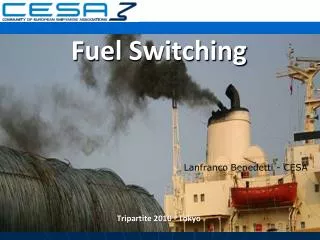
Fuel Switching Challenges and Requirements in Marine Operations: Insights from the 2010 Tripartite Conference
50 likes | 188 Vues
The 2010 Tripartite Conference in Tokyo explored fuel switching requirements under IMO regulations, focusing on specific Emission Control Areas (ECAs) such as North Europe, North America, and Puerto Rico. Key topics included regional legislation, the EU Sulphur Directive, and the California Air Resource Board's guidance. The conference addressed challenges in storage and segregation of multiple fuel types, traditional vessel designs for single fuel usage, and technical issues including low viscosity and safety concerns. Strategies for managing manual and automatic changeovers, cross-contamination, and system integrity were also discussed.


Fuel Switching Challenges and Requirements in Marine Operations: Insights from the 2010 Tripartite Conference
E N D
Presentation Transcript
5.3 Fuel Switching Tripartite, Tokyo, 15th & 16th October 2010
5.3 Fuel Switching - The need to change between Fuels • IMO Requirements • North European SECA (Main Engine and Auxiliaries including boilers) • North American ECA (Main Engine and Auxiliaries including boilers) • Puerto Rico ECA (Main Engine and Auxiliaries including boilers) • Regional Legislation • EU Sulphur Directive (0.1% Sulphur at Berth) (Auxiliary Engines and Boilers) • California Air Resource Board (Main Engine and Auxiliaries excluding boilers)
5.3 Fuel Switching - Challenges • Storage and Segregation of multiple fuel types • Vessels traditionally designed for 1 fuel type. • Transfer lines/equipment. (source of contamination) • Bunkering lines. (source of cross contamination) • Daily Use Tanks. (two or more) • System & Cylinder Oil (Lower TBN) • Switching Activity • Time to change, duplication of pipelines and equipment. • Cross Contamination. • Manual Changeover/Automatic Changeover.
5.3 Fuel Switching - Challenges • Technical Issues • Low viscosity • Manufacturer’s Recommendations (Class Requirement) • Reduced lubricity • Increased wear • Manufacturer’s Recommendations • Temperature Changes • Thermal Shock of equipment • Pipeline flanges loosening • Safety Issues • Using distillate fuel in Boilers • Flame eye’s • Purge time • Duplication of pipe work/burner