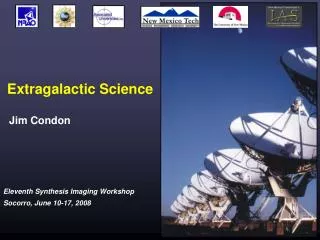
Extragalactic Science
The Twelfth Synthesis Imaging Workshop elucidates the transformative power of synthesis imaging in radio astronomy. Key benefits include higher angular and spectral resolutions, enhanced sensitivity, and improved dynamic range, leading to more accurate astrometric measurements. These advances help overcome challenges such as confusion from background sources and atmospheric effects, allowing for groundbreaking discoveries in astrophysics. This workshop showcases practical applications, including studies of cold gas and star formation in distant galaxies, demonstrating synthesis imaging as a vital tool for modern astronomical research.

Extragalactic Science
E N D
Presentation Transcript
Extragalactic Science Jim Condon
How can synthesis imaging help me do better science? Twelfth Synthesis Imaging Workshop
Science benefits of synthesis imaging • Higher angular resolution: diffraction limited by the size of the array, not by the size of each telescope • Correlation zeros or differentiates out most unwanted effects (e.g., varying atmospheric emission, ground radiation, “1/f” noise, RFI, …) • Higher sensitivity is reached via longer practical integration times and lower “confusion” caused by unresolved background sources • Higher spectral resolution: lag correlators measure frequencies very accurately with clocks, not wavelengths with rulers. • Higher dynamic range is possible because the point-source response can be controlled and modified (e.g., selfcal, clean) and is nearly independent of mechanical pointing errors. • Higher astrometric accuracy by using clocks instead of rulers to determine angles, and eliminating plane-parallel atmospheric refraction Twelfth Synthesis Imaging Workshop
Beating Confusion (GB 300-ft at 1.4 GHz)
NVSS (45 arcsec beam) grayscale under GB 300-ft (12 arcmin beam) contours σc ~ 1 μJy/beam × (θ / 5 arcsec)2 × (ν / 1.4 GHz)-0.7 • “RMS” confusion • c
22 GHz H2O maser disk imaging and astrometry with the HSA = GBT + VLBA Angular resolution: 0.0003 arcsec Spectral resolution: 1 km/s Differential astrometric precision: 0.000002 arcsec ≈ 10-11 radians
Maser rotation curve of UGC 3789 • Distance = 50 ± 7 Mpc • so H0 = 69 ± 11 km/s/Mpc • 1.09 × 10⁷ solar mass BH or dense “star” cluster? • Plummer distribution: • ρ(r) = ρ0 (1 + r2/ c2)−5/2 • Evaporation if N small • Collisions if N large • beam ρ0 > 4 × 10¹¹ Msun/pc3 m* < 0.08 Msun N* > 108 (Braatz et al. ApJ in press)
Science costs of synthesis imaging • Loss of “zero spacing” flux on extended sources (this is primarily a problem for nearby Galactic sources) • Poor surface-brightness sensitivity at high angular resolution because the array area “filling factor” is low • Computational costs may limit total bandwidth, spectral resolution, time resolution, field-of-view, … Complexity also limits multibeaming, pulsar observations, etc. • Quantum noise limits sensitive synthesis imaging to radio frequencies! Twelfth Synthesis Imaging Workshop
The quantum noise limit forcoherent amplification T / ν = h / k = 48 K / THz e.g., ~ 150 K at λ = 100 μm ~ 15000 K at λ = 1 μm Twelfth Synthesis Imaging Workshop
What is the main limitation of radio astronomy? Twelfth Synthesis Imaging Workshop
Normal galaxies example: Mouse vs. elephant MPI Heidelberg 2010 Feb 22
Jet Energy via Radio Bubbles in Hot Cluster Gas Twelfth Synthesis Imaging Workshop
The EOR Quasar at z = 6.42 Walter et al. 2003 • Optical Image
EVLA and ALMA together • EVLA continuous frequency coverage from 1 GHz to 50 GHz • Detect CO at almost any redshift • Study excitation of star-forming gas in distant galaxies
Take-away message: Synthesis imaging is the secret weapon of radio astronomy Twelfth Synthesis Imaging Workshop
The end … Not!