Multiple Intelligences
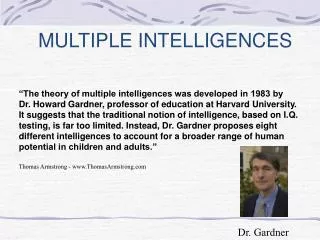
Multiple Intelligences. Zhang Xiaotang. Background. Multiple Intelligences (MI) Traditional IQ tests measure only logic and language, but the brain has other equally important types of intelligence. (Gardner)

Multiple Intelligences
E N D
Presentation Transcript
Multiple Intelligences Zhang Xiaotang
Background • Multiple Intelligences (MI) • Traditional IQ tests measure only logic and language, but the brain has other equally important types of intelligence. (Gardner) • Focus on differences between learners and the need to recognize learner differences in teaching.
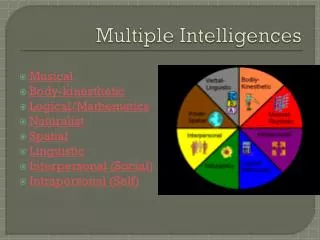
8 native “intelligences”(Gardner) • Linguistic • Logical/mathematical • Spatial • Musical • Bodily/kinesthetic • Interpersonal • Intrapersonal • Naturalist • Other intelligences
Approach • MI theory lacks some of the basic elements——how MI theory relates to any existing language learning theories. • “g” factor
Design • MI pedagory focuses on the language class as the setting for a series of educational support systems aimed at making the language learner a better designer of his/her own learning experiences.
Basic/development sequence • Stage 1:Awaken the Intellinence • Stage 2: Amplify the Intelligence. • Stage 3: Teach with/or the Intelligence. • Stage 4: Transfer of the Intelligence. • (Lazear)
Projects • Multiple intelligence projects • Curriculum-based projects • Thematic-based projects • Resource-based projects • Student-choice projects (Nicholson-Nelson)
The use of the MI model • Play to strength • Variety is the spice • Pick a tool to suit the job • All size fit one. • Me and my people
Roles of the MI model • Teachers become major “contributors to the overall development of students’ intelligences”. (Christison) • Learner are typically expected to take an MI inventory and to develop their own MI profiles based on the inventory. (Page 121) • The MI classroom , the environment and activities are intended to enable students t become more well-rounded individuals and more successful learners in general.
Procedure • Design • Stage 1:Awaken the Intelligence • Stage 2: Amplify the Intelligence. • Stage 3: Teach with/or the Intelligence. • Stage 4: Transfer of the Intelligence.
sensory • Name of the team: • Team members: • Sight: • Sound: • Feel: • Smell: • Size: • What it’s used for: • Name of the object:
An example • Color: blue • Size: small • Name: clip
Spanish • Color: azul • Size: pequeño • Name: clip m. • El clip es azul. • El clip es pequeño.
Conclusion • MI is an increasingly popular approach to characterizing the ways in which learners are unique and to developing instruction to respond to this uniqueness.