Foundations of Democratic Government: Key Concepts and Enlightenment Influences
This overview explores the historic foundations of democratic government, including the essential definitions of government and its purposes. It examines the role of the European Enlightenment thinkers, such as Rousseau, Locke, and Hobbes, in shaping ideas about natural rights, the social contract, and the rule of law. Key documents like the Magna Carta and the English Bill of Rights and their significance in limiting government power and protecting citizens' rights are highlighted. Ultimately, this foundational understanding underscores the commitment to safeguarding human rights and the principles of legitimate governance.

Foundations of Democratic Government: Key Concepts and Enlightenment Influences
E N D
Presentation Transcript
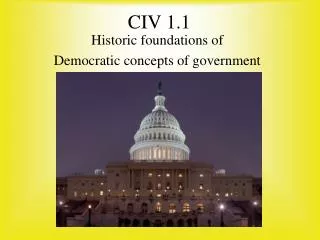
CIV 1.1 Historic foundations of Democratic concepts of government
GOVERNMENT • Definition: • The institutions and processes through which public policies are made for society. • This definition leads to two basic questions: • How should we govern? • What should government do?
PURPOSES OF GOVERNMENT • Helping people cooperate • Safety, Protection • Providing Services • Transportation, Education, Municipal Utilities • Providing Rules • Laws, Organization, Constitution • Putting Ideals into Practice • Protecting basic liberties, assuring people the chance to live peaceable and productive lives
FOUNDATIONS OF DEMOCRATIC GOVERNMENTS • European Enlightenment Thinkers (Philosophers) • Rousseau, Locke, Hobbes, etc. • Higher Law • Rule of Law • State of Nature • Social Contract (Compact) • Natural Rights • Documents: • Magna Carta (1215 A.D.) • English Bill of Rights (1689) • John Locke’s Two Treatises on Government
HIGHER LAW • A law that has to be obeyed by those in authority in the government. 1. lists the basic rights of citizens 2. establishes the responsibility of the government to protect these basic rights 3. it places limits on how people in the government can use powers in three important areas: -citizens rights -how conflicts are resolved -how resources are distributed 4. establishes the principle of private domain 5. can only be changed with the consent of the citizens.
The rule of law is a fundamental component of democratic society all members of society -- both citizens and rulers -- are bound by a set of clearly defined and universally accepted laws. RULE OF LAW
RULE OF LAW • Essential to the safekeeping of social order and civil liberties • relationships with people and the state governed by a set of rules • not governed by groups of individuals • less likely to fall victim to authoritarian rule • calls for individuals and government to submit to the law's supremacy
STATE OF NATURE • The "natural condition of mankind" is what would exist if there were: • no government • no civilization • no laws • no common power to restrain human nature. • "war of all against all," --- human beings constantly seek to destroy each other in an incessant pursuit for power. • Life in the state of nature is "nasty, brutish and short."
SOCIAL CONTRACT THEORY • Jean-Jacques Rousseau: 1762 • “agreement among members of an organized society or between the governed and the government defining and limiting the rights and duties of each” • Promoted by John Locke
SOVEREIGNTY - Popular Sovereignty • “the exclusive right to complete control over an area of governance, people, or oneself.” • Popular Sovereignty = “the belief that the state is created by and therefore subject to the will of its people, who are the source of all political power”
NATURAL RIGHTS • Inborn OR innate rights of humanity such as: • Life • Liberty • Equality • Property • Pursuit of happiness • cannot be denied by society
LIMITED GOVERNMENT • System in which government powers are carefully spelled out to prevent government from becoming too powerful.
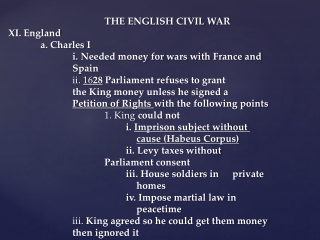
MAGNA CARTA • 1215 • English Nobles (Leaders) forced King John to sign the “Great Charter” • Limited the King’s power • Protected certain rights of noblemen
ENGLISH BILL OF RIGHTS • 1689 • During the Glorious Revolution (Bloodless), English monarchs William of Orange and Mary signed • Spelled out specific rights of Englishmen
TWO TREATISES OF GOVERNMENT • John Locke • Spelled out Government philosophy • Natural Rights • Social Contract theory
THE Declaration of Independence • Thomas Jefferson • Listed reasons for colonies separation from Great Britain • Condenses Enlightenment thinking into one document • Outlines the philosophy of the United States government • Based on ‘consent of the governed’ • If will of the people ignored, we have a right to change the government • Purpose of government is to PROTECT HUMAN RIGHTS