Real-Time Processing of NEXRAD Doppler Radar Data with Continuous SQL Queries
This document discusses the system for streaming, transforming, filtering, and aggregating NEXRAD Doppler radar data for real-time applications. Utilizing a Directed Acyclic Graph (DAG) of operators for performing continuous SQL queries upon the arrival of every event, it addresses challenges related to asynchronous data streams and proposes optimized join windows. The work focuses on enhancing the performance of slow and erratic streams, making it ideal for atmospheric discovery and meteorological purposes.

Real-Time Processing of NEXRAD Doppler Radar Data with Continuous SQL Queries
E N D
Presentation Transcript
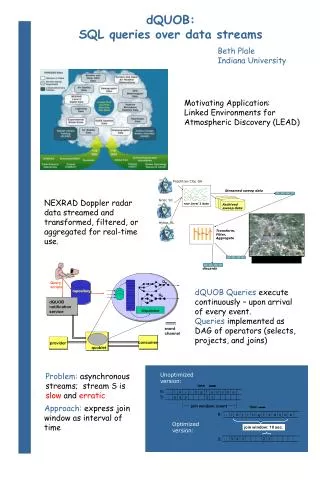
QM Peachtree City, GA QN Streamed sweep data archive dispatcher archive Query scripts Grier, SC Archived sweep data repository dQUOB notification service Hytop, AL Transform, Filter, Aggregate time R: … l k j i h g f e d c b a event channel S: … 5 4 3 2 1 consumer provider quoblet discards raw Level 2 data Beth PlaleIndiana University dQUOB:SQL queries over data streams Motivating Application: Linked Environments for Atmospheric Discovery (LEAD) NEXRAD Doppler radar data streamed and transformed, filtered, or aggregated for real-time use. dQUOB Queries execute continuously – upon arrival of every event. Queries implemented as DAG of operators (selects, projects, and joins) Problem: asynchronous streams; stream S is slow and erratic Unoptimized version: time R: … l k j i h g f e d c b a … S: 5 4 3 2 1 Approach: express join window as interval of time join window: count Optimized version: join window: 10 sec.