Download
1 / 10
110 likes | 237 Vues
This article delves into the concept of limits to the market, examining the ethical implications and reasoning behind certain “blocked exchanges.” It discusses the Pareto principle and what constitutes a market limit, such as ethical concerns regarding transactions. Through various examples, including health and safety laws, slavery, and more, it evaluates when and why exchanges should be blocked. The discussion includes insights from ethical theories and the utilitarian perspective on the implications of blocking exchanges for the welfare of society.

E N D
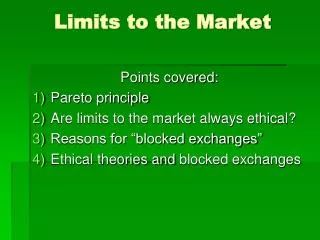
Limits to the Market Points covered: • Pareto principle • Are limits to the market always ethical? • Reasons for “blocked exchanges” • Ethical theories and blocked exchanges
Market exchange Voluntary market exchange conforms to the principle of Pareto improvement. A transaction effects a Pareto improvement if the welfare of at least one of the transactors increases whilst the welfare of other transactor(s) does not decrease.
What is a ‘limit’ to the market? If an item, X, cannot or should not be bought and sold for money, then we may speak of a limit to the market.
Ethical and non-ethical limits to the market Some limits to the market are not (obviously) ethical. Example: one’s place in a queue
‘Blocked exchanges’ People (slavery) (Democratic) electoral votes (Democratic) political office Freedom of speech, religion, press
‘Blocked exchanges’ (cont.) 5) Waiver of health/safety laws (‘desperate exchanges’) 6) Prizes and honours 7) Love and friendship 8) Narcotics, guns.
Reasons for blocking exchange An exchange can transgress our rights. Some exchanges are impossible because they pervert the nature of the thing being exchanged.
Reasons for blocking exchange (cont.) Some exchanges are blocked because they would allow access to harmful goods. Some goods should be allocated according to non-monetary means. Some exchanges are blocked because they would lead to coercion.
Utilitarianism and blocked exchanges Would a utilitarian advocate blocking exchanges if rights are at stake?
Word list p. 97: simony ; p. 98: clandestine p. 99: subterfuge; p. 102: indulgences p. 103: commodious; polymorphous p. 110: to pander p. 112: ostentation