The Myth and Majesty of Leo: Constellation Insights
Explore the fascinating mythology and celestial wonders of the Leo constellation. Known as the Nemean Lion, Leo represents strength and endurance, linked to the legendary labors of Hercules. As one of the oldest constellations in our galaxy, it boasts bright stars like Regulus and Algieba, and is home to the enchanting Leo Triplet of galaxies. Learn about the significance of Leo in Greek mythology and its stellar components, including the ancient Leo Ring and other celestial marvels residing 35 million light-years away from Earth.


The Myth and Majesty of Leo: Constellation Insights
E N D
Presentation Transcript
Constellation Leo Emily Linden Paul Lim
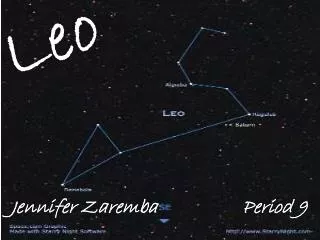
Myth of Leo • In Greek myth Leo is the lion Nemea, which Hercules was commanded to kill as the first of his twelve labors. Since the beast was invincible by arrow or club the contest was a test of physical strength and endurance. Hercules killed the animal by choking it with his bare hands and then wore its skin. • Leo is hot and dry, associated with the full strength of the summer • Is known for royalty, strength, and endurance
The Stars • Regulus: 79 light years from Earth • Denebola: 36 light years from Earth • Algieba: 130 light years from Earth • Zosma: 58.4 light years from Earth • RasElased: 247 light years from Earth • Adhafera: 274 light years from Earth • Rasalas: 133 light years from Earth • Coxa: 165 light years from Earth • Eta Leonis: 2,000 light years from Earth
About Leo • It is about 13 billion years old, making it one of the oldest stars in the Galaxy • The Leo Ring, a cloud of hydrogen and helium gas, is found in orbit of two galaxies found within this constellation • Three galaxies that together form the Leo Triplet: M65, M66, and NGC 3628. • NGC 3628 like our Milky Way, it's a spiral -- a pinwheel that spans at least a hundred thousand light-years. We see its edge so it looks like a streak of light with lanes of dark dust running down the middle • The Leo Triplet is a small group of galaxies about 35 million light-years away in the constellation Leo.
Galaxy NGC 3628 Galaxy M65 Galaxy M66
Works Cited • http://en.wikipedia.org/wiki/Leo_(constellation) • http://www.skyscript.co.uk/leo.html • http://stardate.org/nightsky/constellations/leo