Download

1 / 8
80 likes | 208 Vues
Explore the fascinating dynamics of our Solar System, which includes the Sun and all celestial bodies that orbit it. Learn about planets, categorized as inner and outer, based on their formation from heavier or lighter elements. Inner planets like Mercury, Venus, Earth, and Mars are rocky and dense, while the outer planets—Jupiter, Saturn, Uranus, and Neptune—are much larger and gaseous. Additionally, discover dwarf planets like Pluto, formed from frozen gases and rock. Join us in unraveling the mysteries of our celestial neighborhood!

E N D
Solar System: • The sun and all of the planets and other bodies that travel around it
Planet • A celestial body that orbits the sun, is round because of its own gravity, and has cleared the neighborhood around its orbital path
Solar Nebula: • A rotating cloud of gas and dust from which the sun and planets formed
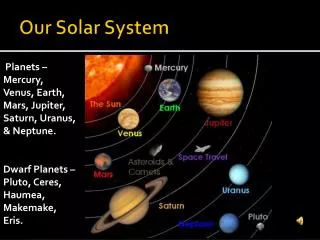
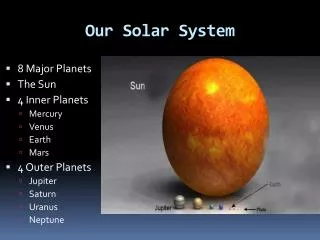
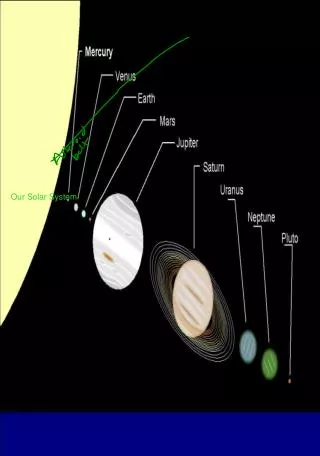
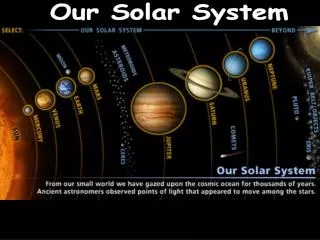
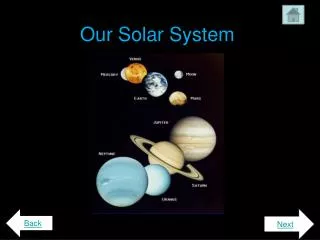
Inner Planets • Formed from much heavier elements such as iron and nickel, with the densest layers settling in the center. Smaller, rockier, and denser than the outer planets • Includes: Mercury, Venus, Earth, and Mars
Outer Planets • Formed in a much colder area, thus they did not lose their gases (helium and hydrogen). Larger gaseous planets. • Includes: Jupiter, Saturn, Uranus, and Neptune
Dwarf Planets • Ice balls made of frozen gases and rock • Includes: Pluto