Ch. 9 Stoichiometry
Stoichiometry is a vital branch of chemistry that explores the mass relationships between elements in compounds and the interactions of reactants and products in chemical reactions. This guide covers the types of stoichiometry including composition and reaction stoichiometry. Key calculations involve mole-to-mole, mass-to-mass, mole-to-mass, and mass-to-mole conversions. Additionally, it discusses limiting reactants, excess reactants, and the concepts of actual and theoretical yield, providing examples to illustrate these fundamental principles.

Ch. 9 Stoichiometry
E N D
Presentation Transcript
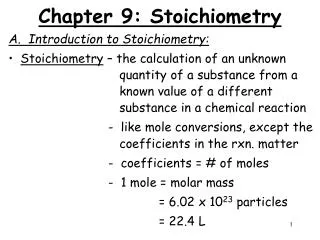
Ch. 9 Stoichiometry • Stoichiometry is a branch of chemistry that deals with the mass relationships of elements in compounds and the mass relationships between reactants and products in chemical reactions. • 2 Types of Stoichiometry • 1. Composition Stoichiometry – is the mass relationships of elements in chemical compounds. • Ex. Molar mass of Li is 6.941 grams
2. Reaction Stoichiometry – is the mass relationship among reactants and products of a chemical reaction. • Ex. NaCl + H2O HCl + NaOH • 58.44g 18.02g 36.46g 40.00g • 4 Reaction – Stoichiometry Problems • 1. Mole to Mole • 2. Mass to Mass • 3. Mole to Mass • 4. Mass to Mole
EXAMPLES ??? • Sample Problems 9.1 – 9.5 • Limiting Reactant is the reactant that limits the amount of the other reactants that can combine, and the amount of products formed in a chemical reaction. • Excess Reactant is the substance that is not used up completely in a reaction. • Ex. If a bus holds 50 people and 60 are waiting to ride the bus, 10 will be left in excess. • Sample problems 9.6 – 9.7
Percent Yield is the ratio of the actual yield to theoretical yield times 100%. • (Actual yield / Theoretical yield) X 100% • Theoretical yield is the maximum amount of product that can be produced from a given amount of reactant. • Actual yield is the measured amount of a product obtained from the product of a reaction. • Sample Problem 9.8