Understanding Electric Fields and Forces in Electrostatics
100 likes | 229 Vues
This detailed overview explores the fundamentals of electric fields and forces, starting with Coulomb’s law and the interaction of point charges. It describes how a charge modifies the surrounding space, creating an electrostatic field and exerting forces on other charges. Key concepts include charge distributions in conductors and the behavior of electric dipoles. Real-world examples illustrate the calculations of electric fields from uniformly distributed charges and dipole interactions. Perfect for students studying electrostatics.


Understanding Electric Fields and Forces in Electrostatics
E N D
Presentation Transcript
TOPIC 2Electric Fieldswww.cbooth.staff.shef.ac.uk/phy101E&M/
Fields & Forces • Coulomb’s law • Qrq • How does q “feel” effect of Q? • Q modifies the surrounding space. • Sets up electrostatic field E • Force on charge q is F = qE • E due to point charge Q is
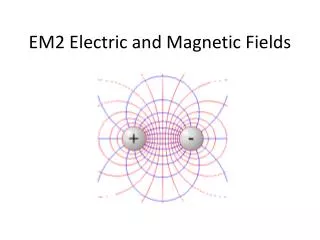
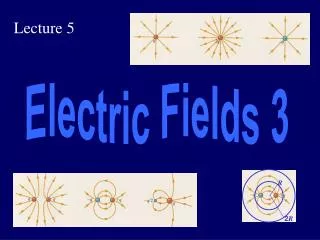
Electrostatic Field Lines • Like charges Unlike charges • Field lines: • Start on positive charge, end on negative • Number proportional to charge • Strength of field = density of field lines • Direction of force at point = tangent to field line.
Conductors • Charges flow in response to a field • Equilibrium no net field within a conductor • Free charges only exist on surface • Consider components of field at surface: • Charge flows until E// = 0 • ETot is always perpendicular to surface of conductor
Continuous Charge Distributions • Divide into charge elements dq • Use superposition • In practice, express dq in terms of position r Use charge density 3D dq = dV dV = element of volume 2D surface dq = dA dA = element of area 1D line dq = d d = element of length
Example 1 A rod of length L carries a charge Q distributed uniformly along its length. If it is centred on the origin and oriented along the y-axis, what is the resulting electric field at points on the x-axis? Solution available on web page Example 2 A charge Q is uniformly distributed along the circumference of a thin ring of radius R. What is the electric field at points along the axis of the ring? For next lecture: revise binomial theorem.
Electric Dipoles Pair of equal & opposite charges, Q & –Q, separated by distance d Dipole moment (vector) p = Qd(direction is from negative to positive charge) Total charge is zero, but still produces and experiences electric fields In uniform electric field, dipole experiences a torque (though no net force)
Pair of equal & opposite forces F = QE Perpendicular separation between lines of forces = d sin Torque = F d sin = Q E d sin = p E sin As vector, = p E i.e. torque acting about centre of dipole, tending to rotate it to align with electric field
Would have to do work to rotate dipole away from aligned position – stored as potential energy. Dipole does work (loses energy) rotating towards aligned position. Define zero of potential energy when dipole is perpendicular to field – = 90°. Rotating to position shown, each charge does work: work =forcedistance = Fd/2 cos Energy of dipole U = – pE cos = – p.E
Example 1 What is the electric field at points on the x-axis due to a dipole formed by a charge Q at x = a/2 and a charge –Q at x = –a/2 , for values of x >> a? Example 2 Two dipoles, with the same charge and separation as above, are placed parallel and a distance apart:(a) parallel to the line of the dipoles (b) perpendicular to the line of the dipoles.In which case is the force between the dipoles greatest?Part (b) is HARD!!