Download
1 / 26
260 likes | 384 Vues
This content provides an overview of costs in production, highlighting fixed and variable costs and their importance in economic analysis. It explains average fixed, average variable, and average total costs, as well as marginal cost. Additionally, it delves into economies and diseconomies of scale, the law of diminishing returns, and the relationship between total, average, and marginal products in production. Understanding these concepts is essential for analyzing a firm's cost structure and optimizing production efficiency.

E N D
Total costs • fixed costs – costs that do not vary with the level of output. Fixed costs are the same at all levels of output (even when output equals zero). • variable costs – costs that vary with the level of output (= 0 when output is zero)
Average fixed cost • Average fixed cost (AFC) = TFC / Q
Average variable cost • Average variable cost (AVC) = TVC / Q
Average total cost • Average total cost (ATC) = TC / Q • ATC = AFC + AVC (since TFC + TVC = TC)
Marginal cost • Marginal cost (MC) = cost of an additional unit of output
AVC, ATC, and MC • Note that the MC curve intersects the AVC and ATC at their respective minimum points
Costcurves • film
Economies and diseconomies of scale • Economies of scale – factors that lower average cost as the size of the firm rises in the long run • Sources: specialization and division of labor, indivisibilities of capital, etc. • Diseconomies of scale – factors that raise average cost as the size of the firm rises in the long run • Sources: increased cost of managing and coordination as firm size rises • Constant returns to scale – average costs do not change as firm size changes (film)
Minimum efficient scale • Minimum efficient scale = lowest level of output at which LRATC is minimized
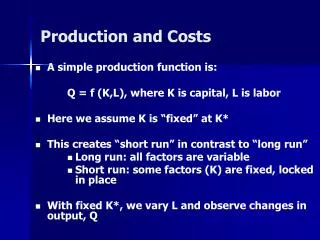
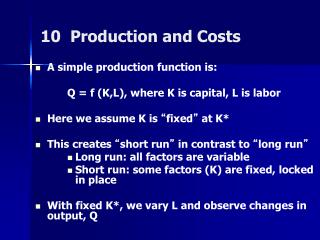
Production • The total amount of output produced by a firm is a function of the levels of input usage by the firm • Total Physical Product (TPP) function - a short-run relationship between the amount of labourand the level of output, ceteris paribus.
Law of diminishing returns • as the level of a variable input rises in a production process in which other inputs are fixed, output ultimately increases by progressively smaller increments.
Average physical product (APP) • APP = TPP / amount of input
Marginal physical product (MPP) • the additional output that results from the use of an additional unit of a variable input, holding other inputs constant • measured as the ratio of the change in output (TPP) to the change in the quantity of labor (or other input) used
Computation of MPP and APP • Note that the MPP is positive when an increase in labor results in an increase in output; a negative MPP occurs when output falls when additional labor is used.
Relationship of APP and MPP • APP rises when MPP > APP • APP falls when MPP < APP • APP is maximized when MPP = APP
Bibliography: • http://www.oswego.edu/~kane/eco101.htm • Czarny B. „Podstawy ekonomii”, PWE, 2002