Understanding Ecology: Interactions, Biomes, and Ecosystems
This introduction to ecology explores the intricate relationships between organisms and their environment, emphasizing the importance of abiotic factors such as temperature, water, and sunlight. It categorizes various biomes like tropical forests and deserts, while discussing their unique characteristics. The text also delves into population dynamics, community interactions, and the principles of energy flow and nutrient cycling within ecosystems. Through examining these elements, we can better appreciate the complexity of life on Earth and the environmental challenges we face.

Understanding Ecology: Interactions, Biomes, and Ecosystems
E N D
Presentation Transcript
ECOLOGY Introduction
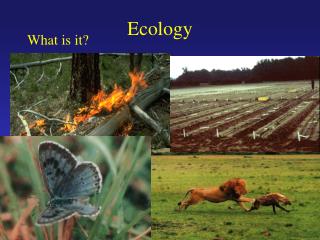
I. WHAT IS ECOLOGY? • study of interactions between organisms & the environment • leads to evaluating of environmental issues
A. Important Abiotic Factors 1. environmental temp. • water • sunlight – drives nearly all • wind – effects temp. • rocks & soil (structure, pH & minerals) • periodic disturbances (fire, hurricanes, volcanoes)
III. The cost & benefits of homeostasis • Regulators: maintain homeostasis through behavioral & physiological mechanisms • Conformers: allow internal conditions to vary w/ external • Principle of allocation: each organism has a limited amount of energy that can be allocated for obtaining nutrients, repro. escaping; so too much for homeo….
Tropical Forest • near equator • temp. varies little • rainforest = greatest diversity
Savanna • grassland w/ scattered trees • S. America & Africa (central & south)
Desert • low & unpredictable precipitation (not temp.) • central Asia & N. Africa
Chaparral • dense, spiny shrubs w/ tough evergreen leaves (along coasts) • periodic fires
Temperate Grasslands • similar to savannas but with cold winters (plains & prairies of U.S.) • soil deep & rich
Temperate Deciduous Forest • midlatitude regions with sufficient moisture to support large, broad-leaved dec. trees
Taiga • coniferous forest • soil thin & acidic
Tundra • permafrost • northern-most limits of plant growth (low shrubby, mat-like vegetation) • not a lot of animals
V. Aquatic Biomes – occupy the largest part of the biosphere • Freshwater – (less than 1% salt) closely linked to terrestrial biomes they are near • Marine – (more than 3% salt) 75% of Earth; algae make most oxygen
Ponds & Lakes • standing bodies of water • vertical stratification in light (aphotic vs. photic) & temperature (thermocline) • oligotrophic = deep, nutrient poor (clear) • eutrophic = shallow, nutrient rich (murky)
Streams & Rivers • bodies of water that move continuously in 1 direction • change in structure & life from headwaters to mouth
Wetlands • covered by water that support aquatic vegetation • hydrophytes live here
Estuaries • area where fresh water stream or river merges with ocean • very productive due to nutrients from rivers • salinity varies
The Intertidal Zone • where land & sea meet; alternately submerged & exposed by tides • Rocky – vertically stratified (attached to harsh) • Sandy – no clear stratification (pred. & scavengers)
Coral Reefs • warm, tropical water where sunlight penetrates to ocean floor (diverse & productive)
Oceanic Pelagic Biome • open waters far from shore • nutrient content low • plankton & nekton prevalent
Benthos • ocean bottom • nutrients from detritus • diverse • low light & temp.
I. Important Characteristics • Density = number of individuals per unit area or volume • Dispersion = clumped, uniform or random
III. Mathematical model for exponential growth describes an idealized population in unlimited environment • Change in population size over time = births – deaths • ZPG = death & birth rates are equal (births & deaths still occur) • Carrying capacity = maximum stable population size that the environment can support over long time period
IV. Factors affecting population growth • Density-dependent * nutrients * territory * accumulation of waste • Density-independent * weather, climate * natural disasters
I. Predation & parasitism (+ - ) interactions • Predation 1. Plant defenses against: thorns, hooks, spines, bad taste, hormones causing abnormal development 2. Animal defenses: hide, escape, coloration 3. Mimicry: to scare or lure prey
Interspecific competitions are(- -) • Inference competition – fighting • Exploitative competition – consumption or use • Niche: how it “fits into” an ecosystem (the organism’s role)
V. Factors that structure communities • Competition • Predation • Environmental patchiness: more heterogeneous the habitat = more diverse community
VI. Succession is the sequence of changes in a community after a disturbance • Ecological succession: transition in species composition over ecological time • Primary succession: begins in areas essentially barren of life due to lack of formed soil or on rubble • Secondary succession: if an existing community has been cleared by some disturbance that leaves soil intact
Climax community: relatively stable state after transitional stages • Disturbances can have positive impact on community: species diversity
ECOSYSTEMS * Involves energy flow & chemical cycling
I. Trophic structure determine an ecosystem’s routes of energy flow & chemical cycling • Food chain – pathway along which food is transferred from trophic level to trophic level • Food web – relationships actually woven & elaborate
Trophic levels: 1. primary producers 2. primary consumers 3. secondary consumers 4. tertiary consumers 5. decomposers
II. An ecosystem’s energy budget depends on primary productivity • Primary productivity: amount of light energy converted to chemical energy by autotrophs of an ecosystem gross: total converted net: total – energy used for respiration
Factors determining productivity: temperature, precipitation, light intensity • As energy flows through an ecosystem, much is lost at each level (85-95% of energy available never transfers to next level) • Only 3-5 trophic levels can be supported • Predators highly susceptible to extinction if ecosystem disturbed
Water Cycle • Sun causes evaporation from ocean --- water rises, cools --- falls as precipitation • Primarily physical
Carbon Cycle • Carbon dioxide into leaf – into biomass – out with respiration • Some carbon diverted in wood, coal, petroleum
Nitrogen Cycle • Atmosphere 80% N2 • Nitrogen only available NH4 (ammonium) & NO3 (nitrate) • Enters ecosystems by atmospheric deposition (5-10% dissolved by rain) or nitrogen fixation
Phosphorus Cycle • Weathering rocks adds P to soil – producers absorb & incorporate – transferred to consumers – back to soil by excretion & decomposition