

SlideServe
Menu
Préférences
© SlideServe · v2026

February 10, 2005

xuxa avatar
1 diapositives · 152 Views · Sep 08, 2014

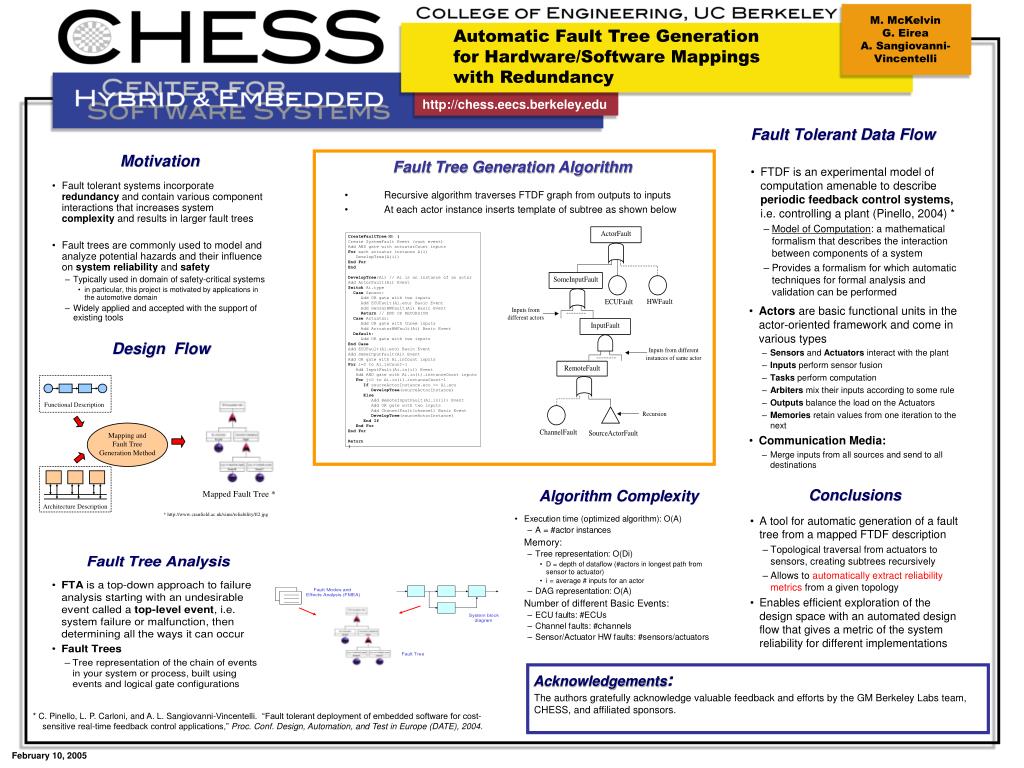
This paper presents a recursive algorithm for generating fault trees from hardware/software mappings integrated with redundancy. The algorithm effectively traverses the Fault Tree Description Framework (FTDF) graph, systematically building fault trees from outputs to inputs. It handles different actor instances, incorporating various fault types for sensors and actuators while maintaining flexibility for complex systems. Acknowledgments are given for the contributions of the GM Berkeley Labs team and supporting organizations. The work aims to enhance fault analysis in embedded systems.
February 10, 2005 - slide 1
01 / 1February 10, 2005
1 / 17

Télécharger la présentation

February 10, 2005
Une image / un lien ci-dessous est fourni (tel quel) pour télécharger la présentation

Politique de téléchargement : le contenu du site vous est fourni TEL QUEL pour votre information et votre usage personnel ; il ne peut être vendu, concédé sous licence ni partagé sur d’autres sites sans l’accord de son auteur.Le contenu vous est fourni TEL QUEL, pour votre information et votre usage personnel uniquement. Téléchargez la présentation en cliquant sur ce lien. Lors du téléchargement, si vous ne parvenez pas à télécharger une présentation, l’éditeur a peut-être supprimé le fichier de son serveur.Pendant le téléchargement, si vous ne parvenez pas à obtenir une présentation, le fichier a peut-être été supprimé par l’éditeur.

F I N

Plus de contenu associé

Transcription de la présentation
  1. M. McKelvin G. Eirea A. Sangiovanni- Vincentelli Automatic Fault Tree Generationfor Hardware/Software Mappings with Redundancy http://chess.eecs.berkeley.edu Fault Tree Generation Algorithm • Recursive algorithm traverses FTDF graph from outputs to inputs • At each actor instance inserts template of subtree as shown below CreateFaultTree(G) { Create SystemFault Event (root event) Add AND gate with actuatorCount inputs For each actuator instance A(i) DevelopTree(A(i)) End For End DevelopTree(Ai) // Ai is an instance of an actor Add ActorFault(Ai) Event Switch Ai.type Case Sensor: Add OR gate with two inputs Add ECUFault(Ai.ecu) Basic Event Add SensorHWFault(Ai) Basic Event Return // END OF RECURSION Case Actuator: Add OR gate with three inputs Add ActuatorHWFault(Ai) Basic Event Default: Add OR gate with two inputs End Case Add ECUFault(Ai.ecu) Basic Event Add SomeInputFault(Ai) Event Add OR gate with Ai.inCount inputs For i=0 to Ai.inCount-1 Add InputFault(Ai.in(i)) Event Add AND gate with Ai.in(i).instanceCount inputs For j=0 to Ai.in(i).instanceCount-1 If sourceActorInstance.ecu == Ai.ecu DevelopTree(sourceActorInstance) Else Add RemoteInputFault(Ai.in(i)) Event Add OR gate with two inputs Add ChannelFault(channel) Basic Event DevelopTree(sourceActorInstance) End If End For End For Return } Acknowledgements: The authors gratefully acknowledge valuable feedback and efforts by the GM Berkeley Labs team, CHESS, and affiliated sponsors. * C. Pinello, L. P. Carloni, and A. L. Sangiovanni-Vincentelli. “Fault tolerant deployment of embedded software for cost-sensitive real-time feedback control applications,” Proc. Conf. Design, Automation, and Test in Europe (DATE), 2004. February 10, 2005