Download
1 / 13
130 likes | 244 Vues
The Massachusetts Stretch Energy Code aims to improve energy efficiency in new and existing buildings. Key factors affecting energy use include building size, air leakage, and equipment efficiency. With a uniform state-wide code established, local enforcement by municipal officials ensures compliance with guidelines for fire protection, HVAC, plumbing, and electrical standards. The code promotes sustainable practices by adopting the latest version of the IECC and incentivizes builders through rebates and training. Home Energy Rating System (HERS) assessments ensure ongoing performance optimization in residential and commercial properties.

E N D
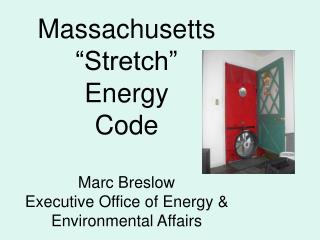
Massachusetts“Stretch” Energy Code Marc Breslow Executive Office of Energy & Environmental Affairs
What affects energy use? • Size of building (external surface area) • Air leakage – through holes in attic, walls, basement ceiling, heat/AC ducts and pipes • Heat transfer through solid materials – can reduce with insulation • Efficiency of equipment: heating and cooling systems, appliances, lighting
MA Building Code • Uniform ‘State-Wide’ Code in place since ’75 • Board of Building Regulation and Standards (BBRS) oversees the code; changes, appeals, etc. • Pertains to all buildings in state; two volumes: • One- and Two-Family Dwelling Code and • Basic Code for all other buildings • Enforcement by municipal building officials • Scope, including but not limited to: • Fire Protection • Structure • HVAC • Plumbing, Electrical • Energy Conservation
New Mass. Base Code • Green Communities Act (2008) requires that Mass. adopt the latest version of the International Energy Efficiency Code (IECC) within one year of publication • 2009 IECC in effect now as an option, becomes mandatory July 2010 • For commercial buildings, IECC is similar to ASHRAE 90.1 standard
Residential stretch code based on ‘Energy Star’ Proven cost-effective program 15% of new construction in MA Builder incentives/rebates $1250/home for HERS 65 Rebates on appliances, heating and cooling, lighting, etc. Builder training and materials Subsidized HERS raters
Residential New Construction • Performance only ‘stretch’ option • Uses Home Energy Rating System (HERS) • 70 or less < 3,000 sq ft. • 65 or less > 3,000 sq ft. • Requires a certified HERS rater • Review building plans • Check insulation installation • Blower-door and duct testing Image source: www.lexingtoninfrared.com/hers-ratings.php
Home additions/renovations • Two options – performance (HERS rating) or prescriptive (install specific items) • Rating option for additions: same HERS as new homes • Rating option for renovations: HERS 80 > 2,000 square feet HERS 85 < 2,000 square feet • Prescriptive option: meet Energy Star homes requirements for additions; for renovations, only meet requirements for items being changed (windows, walls, etc.)
Efficiency steps to reach HERS 60 • Conditioned basement (heat/AC) • Foundation walls R10 insulation • Above-grade walls R22 insulation • Energy Star windows- U-factor 0.33 (heat loss rating) • Attic ceiling R38 cellulose insulation • Slope ceiling R32 cellulose insulation • Air leakage: 4 air changes/hour at 50 Pascals pressure (created by high-power fan) • Natural gas furnace 0.94 efficiency • Central Air Conditioner - 3 ton 15 SEER (efficiency) • Domestic Hot Water - 0.62 efficiency natural gas tank • Programmable thermostat • 75 percent fluorescent lighting
Cash-Flow for HERS 60 new home: 2,672 square feet, 3 bedrooms • Improvement Costs $ 8,103 • Mortgage Interest Rate 5% • Loan Term (Years) 30 • Annual Incremental Mortgage Payment $527 • Annual Energy Costs $ 3,103 • Annual Energy Savings from Baseline $1,364 • Annual Cash Flow Gain $ 837
Commercial Stretch Code Requirements (new construction only, renovations exempt)