Optimizing T7 PCR Product Cloning and Transformation in HT115 DE3 E. coli
This document outlines the process for cloning T7 PCR products using specific restriction enzymes (EcoRI, PmeI, NotI, PstI, SpeI) and transforming them into HT115 DE3 E. coli. It discusses effective and ineffective orientations of the PCR product in relation to the cloning vector. Detailed protocols are provided for growing competent cells, preparing LB medium with tetracycline, and spreading transformed cells on selective plates. Focusing on RNase III mutation impacts and T7 RNA polymerase induction, this guide aims at ensuring successful RNA interference studies.

Optimizing T7 PCR Product Cloning and Transformation in HT115 DE3 E. coli
E N D
Presentation Transcript
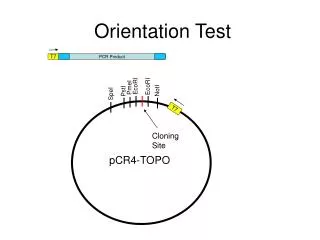
Orientation Test T7 PCR Product EcoRI EcoRI PmeI NotI PstI SpeI T7 Cloning Site pCR4-TOPO
EcoRI EcoRI PmeI NotI PstI SpeI T7 PCR Product T7 Effective Orientation EcoRI EcoRI PmeI NotI PstI SpeI PCR Product T7 T7 Ineffective Orientation
SpeI EcoRI EcoRI PmeI NotI PstI SpeI T7 PCR Product T7 Vector (~4000bp) + Small PCR Frag Digest SpeI Effective Orientation SpeI EcoRI EcoRI PmeI NotI PstI SpeI PCR Product T7 T7 Vector (~4000bp) + Larger PCR Frag Digest SpeI Ineffective Orientation
HT115 DE3 • E. coli Strain • Null mutation of rnc null (RNaseIII) • RNase III degrades double stranded RNA • DE3 – lambda lysogen • containing IPTG inducible T7 RNA polymerase • Lysogen contains tet resistance gene Timmons L, Court DL, Fire A (2003)
Transformation • Wednesday • Add Tetracyline to LB broth • Inoculate with culture of HT115 DE3 • Grow O/N 37° • Thursday AM • Prepare second flask of LB+tet • Inoculate with 500ml of overnight culture HT115DE3. • Grow ~4 hours • Thursday PM • Treat Cells with CaCl to make competent • Mix cells with RNAi vector • Spread on LB + tet + amp plates • Grow O/N 37°