Regimes in LDCs
160 likes | 281 Vues
This analysis delves into the political regimes of less developed countries (LDCs), contrasting authoritarian developmental (AD) and predatory (AP) governance models. AD regimes, exemplified by South Korea and Taiwan, foster development and enhance citizen capabilities. In contrast, AP regimes, like Nigeria and the Democratic Republic of Congo, hinder development and concentrate wealth among elites. The paper explores how political structures, policymaking, and institutional capacities influence economic outcomes and citizen welfare, highlighting the importance of stable political institutions for sustainable development.


Regimes in LDCs
E N D
Presentation Transcript
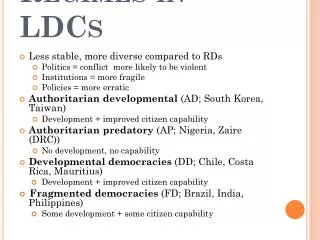
Regimes in LDCs • Less stable, more diverse compared to RDs • Politics = conflict more likely to be violent • Institutions = more fragile • Policies = more erratic • Authoritarian developmental (AD; South Korea, Taiwan) • Development + improved citizen capability • Authoritarian predatory (AP; Nigeria, Zaire (DRC)) • No development, no capability • Developmental democracies (DD; Chile, Costa Rica, Mauritius) • Development + improved citizen capability • Fragmented democracies (FD; Brazil, India, Philippines) • Some development + some citizen capability
AD: Politics • Geography, politics • Powerful enemies • Threat of internal unrest • Absence of natural resources • Incentives to promote economic development, share wealth • Nationalism, anticommunism • Support in key constituencies • Entrepreneurs/capitalists • Farmers • Workers paid cost of industrialization; over time enjoyed more benefits
AD: Policies • Rapid industrialization; competitiveness • Import substitution industrialization (ISI) • Manufacture for export, Export-oriented industrialization (EOI) • Not market capitalism model • Japan’s state-led development model
AD: Institutions • Centralized political system (power concentrated in small elite; executive) • Legislatures, courts, local government not effective check • Strong, coherent state • Effective policy implementation • Officials autonomous, competent, professional • Close relationship to business community • Institutions devoted to legitimation and security • Elections • Schools, media • Security, repression
AP: Politics • No economic, no human development • Little incentive • Plagued by ethnic, linguistic, regional conflicts • Class interests submerged • Narrow coalitions -- ethnic, linguistic, regional loyalties • Clientelism = patron gives client favors for support • Divide and rule; intimidation • Clientelist politicians • Narrow, geographically defined constituencies • Patronage to supporters • Most get little benefit
AP: Policies • Goal of leaders = enrich themselves, families, followers • Economic development – concentrate wealth in elite hands • ISI accumulation of wealth by leaders • Human development policies (education, health care) opportunities for making money • School, clinic construction – kickbacks, graft
AP: institutions • Weak states – no capacity, autonomy • Political parties – no clear policy goals • Weak legislatures • Corrupt bureaucracies • State unable to deliver basic goods and services • Inadequate infrastructure • Limited protection of property rights • Inefficient firms protected • Inefficient management of foreign investment, aid
Authoritarian regimes • Why are some developmental (AD), others predatory (AP)? (see Table 8.1, 225) • Incentives leaders have to build broad/narrow coalitions • Quality of state institutions for implementing policies • Kinds of groups and social classes for coalitions of support
DD: Politics • Democracy, economic growth, and human development; mutually reinforcing • Consolidating democracy convincing social groups/classes they benefit from democracy • Meet needs of poor; do not threaten interests of wealthier groups • Trade-offs broad-based social democratic political parties, federations of labor and business, capable, coherent state bureaucracies • Compromise political influence to agricultural workers, small farmers, and urban workers
DD: Policies • Strong social democratic parties • Capitalist economic growth, substantial safety nets • Minimal state ownership • Growth with equity • Export-led growth, integration into global market • Substantial social welfare programs • Strengthened labor union bargaining power • Increased citizens’ capability
DD: Institutions • Stable, broad-based political parties • Capable, coherent state bureaucracies • Parties appeal to broad groups of voters through policies that promote growth with equity • Broad-based labor and business federations • Represent workers and businesses in most sectors • Strong, autonomous states • Implement policies favoring broad categories of population • Bureaucracies with capable officials; coherent, successful policy-making, implementation
FD: Politics • Fragmented political parties, interest associations, states • Large inequalities in wealth, power, citizen capability; large and diverse populations • Politicians appeal to upper income groups • Clientelism inhibits peasants and workers • Rulers engage in identity politics • Politicians engage in populism • Governments target benefits to privileged groups, organized workers • Local elites manipulate elections
FD: policies • Benefits go to wealthier business people, union leaders, large farmers, middle class • ISI protects businesses; gives subsidies to large farmers • Educational, health care, retirement, unemployment geared to upper- and middle-classes • Policies biased toward urban middle-class and wealthy, some improvements in lives of poor
FD: institutions • Fragmented political institutions • Multiple political parties, interest groups, federal systems • Parties rely on patronage, appeals to racial and ethnic identity • Legislators focus on pork barrel projects, local benefits • Fragmentation within state prevents implementation of coherent programs
Democratic Regimes • Why some developmental (DD), others fragmented (FD)? (Table 8.4, 236) • Incentives leaders have for broad/narrow coalitions • Quality of state institutions for implementing policies • Groups and social classes for coalitions of support • Political parties, interest groups broad-based or fragmented
Comparing capability • Physical well-being • AD/DD > FD > AP (Table 8.5, 237; Table 8.6, 238) • Informed decision-making • AD > DD > FD > AP (Table 8.7, 239) • Safety • AD > DD > FD > AP (Table 8.8, 240) • Civil and political rights • DD > FD > AD > AP (Table 8.9, 241)