Download
1 / 8
80 likes | 208 Vues
This analysis explores the political and economic landscapes of Russia and China after the fall of communism. The dominance of the Communist Party in both nations has led to distinct governance styles characterized by varying degrees of state intervention, and the challenges posed by socio-economic divides. Russia’s “competitive authoritarianism” contrasts with China’s “socialism with Chinese characteristics,” highlighting issues of efficiency, productivity, and social welfare. The paper also discusses key institutions, political cleavages, and their implications for future governance and stability in these countries.

E N D
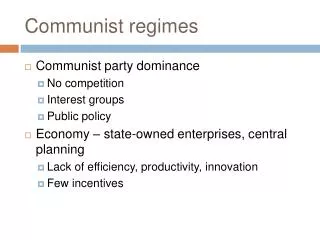
Communist regimes • Communist party dominance • No competition • Interest groups • Public policy • Economy – state-owned enterprises, central planning • Lack of efficiency, productivity, innovation • Few incentives
Russia – Politics • Political cleavages • Markets vs. State, Political elites vs. Oligarchs, Regional leaders vs. central government, Russians vs. Chechens • Economic policy • “Shock therapy” • More recently -- state control over key sectors; markets • Conservative governments (Putin and Medvedev) (United Russia Party) • Market economy, middle class, nationalism, order, stability • Fragmented interest groups • “Competitive authoritarian”
Russia – Policies • Economy • Markets plus significant state role in key industries (state-owned, state-directed industries in oil and gas) • Redistribution of income from poor to rich • Reduction in social spending • Reduction in taxes • Large numbers living in poverty
Russia – Institutions • Constitution (1993) (Figure 10.1, 310) • Strong president • Premier • Bicameral legislature • Lower house – State Duma • PR • more powerful; weak relative to executive • Upper house – Federation Council • appointed by governors, regional legislatures • Judiciary • No check on executive power; widespread corruption • Bureaucracy • Ineffective; corrupt • Russia’s future?
China – Politics • Chinese Communist Party (CCP) dominant • Cleavages from economic reforms • Social classes = capitalist class, middle class, urban poor • Growing income inequality, class divide = challenge for CCP • Urban vs. rural • CCP’s legitimacy • Socialism economic development • Co-optation and coercion • Elite-based, exclusivist ruling coalition
China – Policies • “Socialism with Chinese characteristics” • Markets; privately owned firms • Small, medium-sized state-owned firms • Competitive • Socialist (state-owned enterprises, farms) • Outcome • Growth reduction in poverty • Unemployment, income inequality, urban growth • Dark side of markets • Insufficient social welfare spending • New policies
China – Institutions • Dominance by CCP (Figure 10.2, 327) • Power resides in “paramount leader” and elite party officials • All major political decisions made in Politburo and Standing Committee • Governmental institutions are administrative arm of CCP • No independent judiciary • China’s future?
Russia and China Compared • Table 10.1, 332 • Russia considerably higher per capita income • Physical needs and informed decisions • Russia’s record better overall, but China catching up • Safety • China’s record is better • Civil and political rights • Nearly equally bad