Compensating for Anther Envy in Mimulus guttatus: Insights on Hermaphroditism and Female Fitness
220 likes | 344 Vues
This study explores the reproductive dynamics in Mimulus guttatus, focusing on how female plants compensate for reproductive costs in a hermaphroditic population. Conducted at Blandy Experimental Farm, the research investigates female plant characteristics, including flower size, fruit, and ovule production. It also examines pollinator preferences, discovering that though female plants attract more attention with larger displays, hermaphrodites receive longer visits from pollinators. The findings illuminate strategies female plants employ to thrive in an environment dominated by hermaphrodites.


Compensating for Anther Envy in Mimulus guttatus: Insights on Hermaphroditism and Female Fitness
E N D
Presentation Transcript
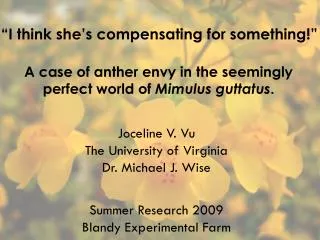
“I think she’s compensating for something!” Joceline V. VuThe University of VirginiaDr. Michael J. Wise Summer Research 2009Blandy Experimental Farm A case of anther envy in the seemingly perfect world of Mimulus guttatus.
hermaphroditism gynodioecy dioecy monoecy Breeding Systems in Plants
Problem of Interest ? male-sterility: reproductive cost How can females compensate in a hermaphroditic population?
Hermaphrodite (perfect) Male-Sterile (Female)
Questions Compensating for reproductive costs • Fecundity? • Pollinator attraction? Plant Performance Experiment Plant Performance Experiment Pollinator Preference Experiment
Methods 1392 seedlings 611 from female lines 606 from perfect lines 316 295“sterile-sibling perfect” 13 593
Plant Performance Experiment Fruit Count Ovule Count Fruit Count Corolla Width and Length Fruit Count Ovule Count Ovule Count Corolla Width and Length Corolla Width and Length
Female flowers are larger than perfect flowers Corolla Width Corolla Length P = 0.01 p = 0.01 p < 0.0001
Females produce more fruits and more ovules/fruit Fruit Number Ovule Number p < 0.0001 p < 0.0001
Summary: Plant Performance Females have bigger flowers, more fruits, and more ovules/fruit
Pollinator Preference Floral Display, Plant Visits, Flowers/Plant Visit
Female plants have a larger floral display a b b a a b b b b Trial 1 Trial 2 Trial 3 but…
Flower visits per plant visit is higher for perfect plants than females b b ab b ab a a a a Trial 1 Trial 2 Trial 3
Floral display affects flower visits per plant visit for perfect flowers Hermaphrodites:r = 0.30; p = 0.002 Females:r = 0.10; p = 0.35
Summary: Pollinator Preference Bees visit all plants equallyOnce on a hermaphrodite, they stay longer Fertilization? Inbreeding?
Conclusions Can female plants compensate enough to compete in a perfect world?fecunditypollination