Understanding Low Impact Development: Benefits, Challenges, and Effective Strategies
Low Impact Development (LID) is a sustainable approach aimed at managing urban drainage to mitigate environmental impacts. This article explores the principles of LID, including bioretention, harvesting, and reuse, contrasting conventional drainage methods that focus on "collect and convey." It highlights the design objectives necessary for effective drainage, such as promoting infiltration and managing high flows. Additionally, the challenges and controversies surrounding the LID mandate, such as implementation costs and regulatory hurdles, are discussed. Strategies for successful LID implementation focus on optimizing site layouts and maximizing water quality benefits.


Understanding Low Impact Development: Benefits, Challenges, and Effective Strategies
E N D
Presentation Transcript
Low Impact Development Why and How; What’s Working and What Isn’t
Topics • How Low Impact Development can mitigate effects of urban drainage • Applying design criteria for bioretention and harvesting/reuse • Why is LID controversial? • The LID mandate: Problems and possible solutions
Conventional Urban Drainage • Features • Impervious surfaces: roofs and pavement • Catch basins and piped drainage • “Collect and convey” design objective
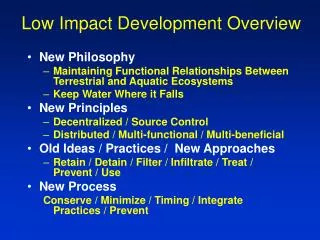
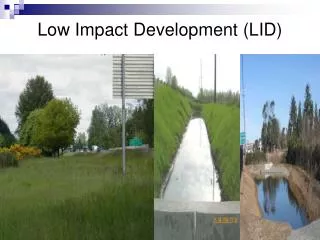
LID Drainage Principles • Instead of “collect and convey,” “slow it, spread it, sink it.” • Avoid concentrating flows • Keep drainage areas small • Promote infiltration • Detain • Treat • Route high flows so theyflood safely
LID Design Steps • Optimize the site layout
LID Design Steps • Optimize the site layout • Use pervious surfaces and green roofs where possible
LID Design Steps • Optimize the site layout • Use pervious surfaces and green roofs where possible • Disperse runoff to landscaping
LID Design Steps • Optimize the site layout • Use pervious surfaces and green roofs where possible • Disperse runoff to landscaping • Direct drainage from impervious surfaces to bioretention facilities, flow-through planters, or dry wells
Sizing Treatment Facilities One Acre Vary V until 80% is detained and 20% overflows V 48-hourdrawdown Largest storm retained 85th percentile, 24 hour 0.5" - 1.0" storm depth 0.2 inches per hour
Bioretention evapotranspiration infiltration
Sizing Criterion i = 0.2 inches/hour BMP Area/Impervious Area = 0.2/5 = 0.04 Surface Loading Rate i = 5 inches/hour
Harvesting and Reuse • Facility must fully drain within specified drawdown time • No way to “credit” removal of a portion for reuse unless drawdown is regular and predictable WaterQualityVolume
Why is LID Controversial? • Municipalities can pass implementation costs on to developers • With a 4% sizing factor, nearly all projects can implement bioretention • Costs are reasonable (<<1% of project cost) • Bioretention technology is increasingly well-defined and well-known • Bioretention has a strong track record with hundreds of projects of all types built and in operation
Messing with Success • Bioretention not allowed unless infiltration, evapotranspiration, and harvesting/reuse are infeasible • Poorly targeted exceptions for high-density, “smart growth” infill projects • Regulatory rationale: “We have a feeling” • Mandate for off-site and in-lieu programs • Ever-increasing reporting requirements • Invalid technical specifications written into permits
LID: What we need now • Focus on maximizing water quality benefit • Trust and cooperation • Fact-based decision-making • Continuous Improvement • Patience and Fortitude