Understanding Similar Polygons and the Golden Ratio
This chapter focuses on identifying and applying the concepts of similar polygons and the similarity ratio. It defines similar figures, emphasizing that they have the same shape but not necessarily the same size. The chapter explains how two polygons are considered similar if their corresponding angles are congruent and their corresponding sides are proportional. Additionally, it introduces golden rectangles and the golden ratio, showcasing their significance in art and design, including famous artworks like the Mona Lisa. Students will engage with examples to reinforce their understanding of these concepts.

Understanding Similar Polygons and the Golden Ratio
E N D
Presentation Transcript
Chapter7: Similarity Section 7-2: Similar Polygons
Objectives • To identify similar polygons. • To apply similar polygons.
Vocabulary • Similar • Similarity Ratio • Golden Rectangle • Golden Ratio
Similar Figures • Similar figures are figures that have the same shape, but not necessarily the same size.
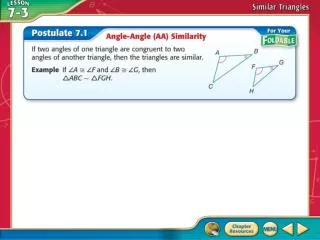
Similar Polygons • Two polygons are similar if: • Corresponding angles are congruent. • Corresponding sides are proportional.
Similarity Ratio • The ratio of the lengths of corresponding sides is the similarity ratio.
Understanding Similarity • ABCD ~ EFGH
Determining Similarity • Determine whether the triangles are similar. If they are, write a similarity statement and give the similarity ratio.
Using Similar Figures • LMNO ~ QRST • Find the value of x.
Golden Rectangle • A golden rectangle is a rectangle that can be divided into a square and a rectangle that is similar to the original rectangle.
Golden Ratio • In any golden rectangle, the length and the width are in the golden ratio, which is about 1.618…..:1
Golden Ratio in Art • The Mona Lisa is one piece of art work that contains the golden ratio.
Example: Art • An artist plans to paint a picture. He wants the canvas to be a golden rectangle with its longer horizontal sides 30 cm wide. How high should the canvas be?