Download
1 / 23
230 likes | 346 Vues
This guide provides essential insights into effective lawn weed management, featuring expert advice from Dr. John Stier, an Environmental Turfgrass Extension Specialist at the University of Wisconsin-Madison. Weeds often signal underlying issues in lawn care, such as turf management techniques, mowing heights, and soil fertility. Discover the importance of proper irrigation, species selection, and the use of pre-emergent and post-emergent herbicides. Learn about choosing effective products and the significance of integrated pest management for a healthier lawn.

E N D
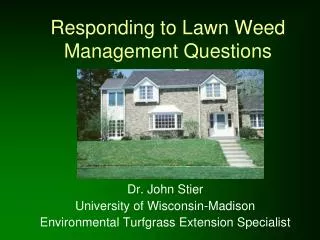
Responding to Lawn Weed Management Questions Dr. John Stier University of Wisconsin-Madison Environmental Turfgrass Extension Specialist
Presence of Weeds Usually Indicates Underlying Problem Turfgrasses adapted to the local environment resist weeds best
Good Turf Management • Mowing • 2-3 inch height: 1/3 Rule • Sharp blades • Fertility • 3-4 lb N/1000 ft2: Holiday Schedule • Irrigation • Turf species • Kentucky bluegrass/perennial ryegrass • Fine fescue: low maintenance, dry shade • Rough or supina bluegrasses for moist shade
Moss and Algae • Low light • Restricted air movement • Poor drainage • Often compounded by poor management
Why do I Have Weeds in My Lawn Again This Year? • Correct product used? • Age, storage • Rate? • Timing? • Rain, growing conditions • Temperature • Low-restrict absorption/translocation • Warm to mod. high-best absorption/translocation • V. high-dries on surface prior to absorption • Turf cover & management
Post-Emergent Grassy Weed Control • Difficult • Annuals: crabgrass • MSMA: retail • Perennials: tall fescue, bentgrass, quackgrass, nimblewill • Glyphosate (Roundup, Kleenup)
Creeping Bentgrass • Poor quality seed • May take years to become noticeable • Puffy patch, small-leaved grass • Fine stolons easily ripped up • Spray glyphosate 1 ft past perimeter of patch Bentgrass patch 1 ft stolons
Pre-Emergent Weed Herbicides • Form barrier between soil surface and seed • Irrigation or rainfall • Prevent seed germination • apply March-April • Used for annual grasses, some broadleaves • Will stop perennial germination • Examples: pendimethalin dithiopyr (some post-emergent) siduron--OK for seeding
Spring and summer Light green color Brown after frost Short, wide leaves Fine hairs on leaves/stem Easy to pull plant Perennial Gray-green color Longer, narrower leaves Few hairs Auricles Can’t pull plant Rhizomes Crabgrass and Quackgrass
Post-Emergent Broadleaf Herbicides • Apply to visible weeds when actively growing • Broadleaf weed control: 2,4-D; MCPP; MCPA; dicamba; triclopyr • Sold in combinations (e.g., Weed-B-Gon) • Dicamba is soil mobile, can damage taxus, junipers, others
Factors Affecting Herbicide Control Wild violet • Formulations • Esters • volatile • readily absorbed • use during cool temps or hard-to-kill weeds • Salts • less volatile • use during hot temps • less smell
Weed and Feed Products • Herbicide impregnated on fertilizer prill • Post or pre-emergence • Post: Stick to leaves? • Pre: Timing?
“Non-Toxic” Pesticides • Misnomer: Pesticides intended to be toxic to pests • EPA regulates toxicity: no significant danger when used properly • Avoid reliance on non-regulated “biological” or “organic” pesticides • May not work • No toxicity testing!
LD50 and LC50 Measure & Rate Acute Toxicity • Amount to kill 50% of animals = Lethal Dose to 50% (LD50) • LC50 = Inhalation Toxicity • Lower LD or LC50 values = More toxic!
Toxicity of Common Substances LD50 3500 ppm = 10 oz ai/180 lb adult Source: Pesticide profiles: Toxicity, environmental impact, & fate. 1997. M.A. Karmin (ed). Lewis Publishers *Source: Applied weed science. 1999. M.A. Ross & C.A. Lembi. Prentice-Hall.
EPA: 2,4-D Not Linked to Human Cancer (9 Aug. 2007) • 300 studies since 1989 • "Based on extensive scientific review of many epidemiology and animal studies, the Agency finds that the weight of the evidence does not support a conclusion that 2,4-D, 2,4-DB and 2,4-DP are likely human carcinogens," according to a notice released by EPA.
Pesticide Fate Photodecomposition (Volatilize) Pesticide Applied (Drift) Runoff ? Plant Uptake & Degradation Thatch Adsorption Microbial decomposition Soil Chemistry Reactions and Decomposition Leaching?
Corn Gluten Meal • Accidental discovery • Research-based! • Activity • Herbicidal(?) • Fertility (10% N)
Corn Gluten Meal Application • 12-20 lb/M • Early spring • Late summer • Irrigate • Timing critical • Short-lived peptides
Crabgrass Reduction in Field Trials of Corn Gluten Meal on Kentucky Bluegrass Adapted from Christians, N.E. 1993. The use of corn gluten meal as a natural preemergent weed control in turf. ITS No. 7. Intertec Publishing Corp., Overland Park, KS, p. 284-290.
Corn Gluten Meal for Weed Control • High use rates (12-20 lb/M) • One to two applications annually • Expensive: $25-$45 per application/M • Pre-emergent only • Overseeding limitations • Fertility effect
Other Ways to Reduce Risk • Use pesticides only when necessary • Integrated Pest Management • Choose products with lower toxicities • Follow ALL label instructions • Gloves, rates, disposal • Remember… • Risk = Toxicity x Exposure!
Conclusion • A little herbicide goes a long way if… • Turf is properly managed!