Understanding Quadratic Equations Part 2: Real-World Applications and Homework Guide
Dive deeper into quadratic equations with this comprehensive guide focused on practical applications. Learn how to find quadratic equations in standard form (ax² + bx + c), and explore the product and sum of roots. We’ll examine real-world examples such as object motion in physics, including how to model falling objects and calculating their flight time using the quadratic formula. Practice problems and homework assignments are included to reinforce understanding and application of concepts. Perfect for students seeking to master quadratic equations!

Understanding Quadratic Equations Part 2: Real-World Applications and Homework Guide
E N D
Presentation Transcript
Quadratic Formula PART 2 • For an equation in STANDARD FORM a≠0, ax2 + b x + c
Find a quadratic equation Before we look at the answer, lets learn about the product and sum of roots
Physics Formulas Dropping an object h = final height (in feet) t = time (in seconds) h0 = s = initial height (in feet) Sometimes h0 is called s h = final height (in meters) t = time (in seconds) h0 =s = initial height (in meters)
Throwing an object v is the initial velocity. Downward is negative while upwards is positive.
Initial Velocity • Downward is negative while upwards is positive? Why is this? • Let’s look at the whole formula..
What does each part represent??? • We used the -16t2 for the falling object formula….. • -16t2 represents the distance the object falls over time, t, due to gravity • vt represents?? • The distance the object travels because it is thrown or moved by some other force. • So, what determines if v, the velocity is positive or negative? • We are looking at an object falling, so negative values will be towards the ground getting us from some height to 0. • Who wants to explain the formula?
Baton Twirling • When a baton twirler releases the baton into the air, the twirler’s hand is 5 feet above the ground. The twirler will catch the baton when it falls back to a height of 6 feet. The initial velocity is 30 feet per second. How many seconds is the baton in the air?? • Initial velocity v = 30 ft/sec • Initial height s = 5 feet • final height h = 6 feet
6 = -16t2 + 30t + 5 • 16t2 - 30t + 1 = 0 • using the quadratic formula What do those times mean?
A rocket is fired upward with an initial speed of 1960 m/s. after how long does it take to hit the ground?
h=height of ground = 0 meters v=initial velocity = 1960 m/s s=initial height = 0 meters Explain the two solutions!
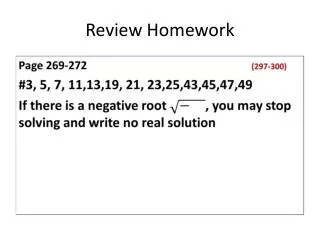
Homework • Page 269-272 (297-300) • #2-8 even • 10-18 even • 42, 46, 48, 61, 62