Download
1 / 5
50 likes | 188 Vues
This discussion focuses on the nuanced relationship between language and identity, drawing from the works of Lippi-Green and Anzaldua. We delve into the concepts of language ideology, including the promotion of dominant group interests at the expense of marginalized voices. Key themes include standard language ideology, language subordination, and communicative burden. Participants are encouraged to engage critically with these ideas and share their reflections via the discussion board. Prepare for an enriching exploration of communication dynamics by contributing your insights and completing the Project Babel proposal.

E N D
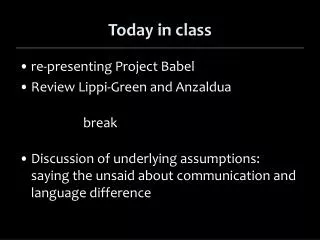
Today in class • re-presenting Project Babel • Review Lippi-Green and Anzaldua break • Discussion of underlying assumptions: saying the unsaid about communication and language difference
Lippi-Green • language is – among other things – a flexible and constantly flexing tool for the emblematic marking of social allegiances (63) • Ideology: the promotion of the needs and interests of a dominant group or class at the expense of marginalized groups, by means of disinformation and misrepresentation of those non-dominant groups (64, paraphrasing Eagleton)
Lippi-Green • standard language ideology: a bias toward an abstracted, idealized, homogeneous spoken language which is imposed and maintained by dominant bloc institutions and which names as its model the written language, but which is drawn primarily form the spoken language of the upper middle class (64) • language subordination: • devaluation of all that is not (or does not seek to be) politically, culturally, or socially mainstream • validation of the social and linguistic values of the dominant institutions (65) • Communicative burden: responsibility in conversation to “collaborate in the establishment of new information” (70, from Clark’s cognitive model of the communicative act)
Anzaldua • What is Anzaldua’s argument? • What is the relationship between language and identity?
for Monday • Read Rubin (no need to bother with chapter intros in the last few paragraphs) • Post microessays to the discussion board by 9pm Sunday • Fill out and print Project Babel proposal • Read the discussion board before class and come ready to talk about the questions on the discussion board