
SlideServe
Menu
Préférences
© SlideServe · v2026

Enhancing Maize Production through Rainwater Harvesting in Chókwè's Semi-Arid Region

yamka avatar
15 diapositives · 290 Views · Oct 04, 2014

This study focuses on utilizing rainwater harvesting (RWH) techniques to improve maize production in Chókwè, a semi-arid region experiencing erratic rainfall patterns. By employing an experimental approach with different catchment area ratios and mulch application, the trials aimed to increase water availability for crops. Results from the 2006-2009 seasons demonstrated that effective RWH can significantly enhance grain yield and water use efficiency (WUE). The findings underline the need to address climate challenges and explore local materials for sustainable agricultural practices.
Enhancing Maize Production through Rainwater Harvesting in Chókwè's Semi-Arid Region - slide 1
01 / 15Enhancing Maize Production through Rainwater Harvesting in Chókwè's Semi-Arid Region
1 / 17

Télécharger la présentation

Enhancing Maize Production through Rainwater Harvesting in Chókwè's Semi-Arid Region
Une image / un lien ci-dessous est fourni (tel quel) pour télécharger la présentation

Politique de téléchargement : le contenu du site vous est fourni TEL QUEL pour votre information et votre usage personnel ; il ne peut être vendu, concédé sous licence ni partagé sur d’autres sites sans l’accord de son auteur.Le contenu vous est fourni TEL QUEL, pour votre information et votre usage personnel uniquement. Téléchargez la présentation en cliquant sur ce lien. Lors du téléchargement, si vous ne parvenez pas à télécharger une présentation, l’éditeur a peut-être supprimé le fichier de son serveur.Pendant le téléchargement, si vous ne parvenez pas à obtenir une présentation, le fichier a peut-être été supprimé par l’éditeur.

F I N

Plus de contenu associé

Transcription de la présentation
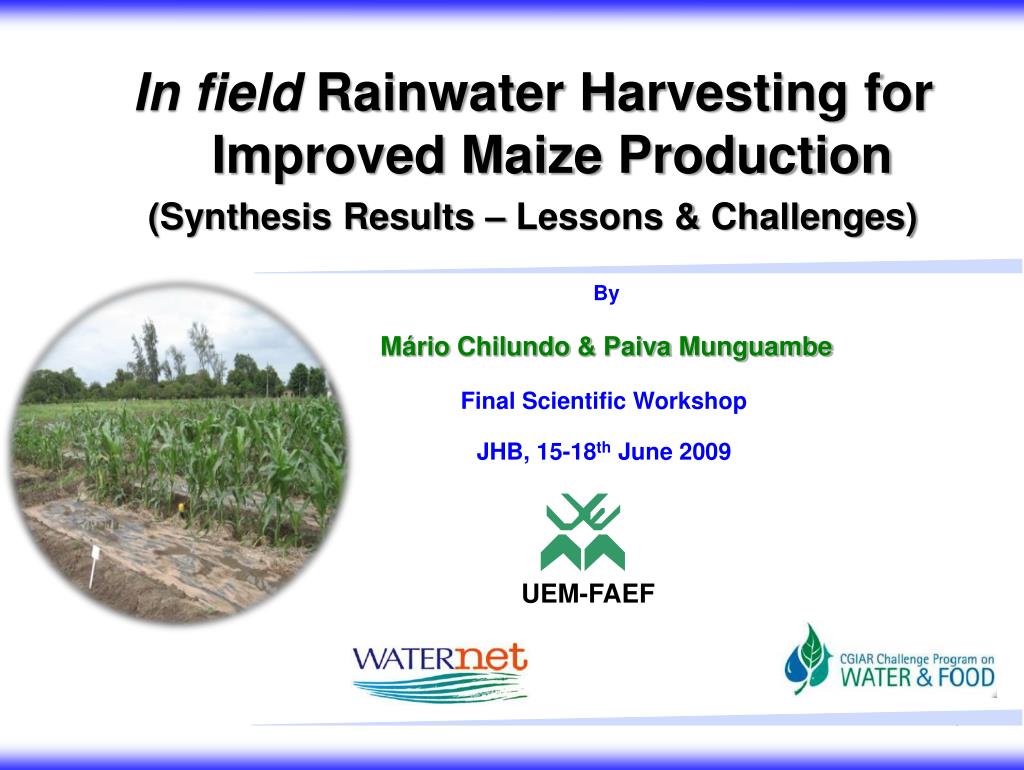
  1. UEM-FAEF • In field Rainwater Harvesting for Improved Maize Production • (Synthesis Results – Lessons & Challenges) By Mário Chilundo & Paiva Munguambe Final Scientific Workshop JHB, 15-18th June 2009

  2. Main Objective of the trials Increase water availability for crop growth though in field water harvesting technique

  3. RWH principle

  4. RWH principle… Chókwè

  5. Introduction… Semi-Arid region October to March: rainy season with 75 % of the annual rain; April to September: dry season with 25 % of the annual rain. Chókwè’s average annual rainfall: 582.0 mm

  6. Balanço hídrico(Pr-ETc) Water balance (Pr-ETc)

  7. Study area Chókwè

  8. Methodology • On station trials (EAC) • Design: RCBD • Crop: Maize (Matuba: 120 days; Potential yield: 5-6 ton/ha) • Seasons (2006/07; 2007/08 and 2008/9) • Mulch: 20 ton/ha (vegetable residues) • Rain gauge: Precipitation • Parameters: plant height and grain yield

  9. RWT principle Plastic cover Runoff • RWT: Catchment area covered by PVC plastic • Ratio: control S80 (80*30 cm; 1:1); S160 (160*30 cm; 1:2) and S240 (240*30 cm; 1:3) – 8 rows/plot (6 effectives+ 2 border) Catchment Area (CTA) 160X30 cm Cropping Area (CA) 80X30 cm Ratio (CTA/CA) = 2:1

  10. Trials…

  11. Maize grain yield (ton/ha) 2007/08 a a growing period growing period Total of 392 mm Total of 471.1 mm b A B 2008/09 C

  12. Results (WUE – Water Productivity)

  13. Estimated Costs (500 m2 plot)

  14. Final remarks/challenges • Ratios 1:2 (S160) and 1:3 (S240) increased water availability for the crop, resulting in higher grain yields per plant and thus increase WUE; • Climate change vs rainfall patterns vs sowing dates need to be addressed because they will have impact on the yields; • Need to test other “local” material as alternative due to high investments costs (plastic) ; • Need to consider IPDM and fertilizers to increase water productivity and yields

  15. OBRIGADO