Photosynthesis
This investigation explores the process of photosynthesis, essential for plant life and the ecosystem. It highlights the unique features of plant cells, including cell walls, vacuoles, and chloroplasts, where photosynthesis occurs. Chlorophyll pigments absorb light energy to convert carbon dioxide and water into oxygen and glucose. The study emphasizes the significance of light for photosynthesis, its impact on oxygen and carbon dioxide levels, and how plants store energy as starch. Learn how plant structures facilitate this vital process and the importance of aquatic plants in maintaining healthy ecosystems.

Photosynthesis
E N D
Presentation Transcript
Investigation One Photosynthesis
Plant Cell • Plant cells are slightly different from animal cells • Contain most of the same organelles plus a few more • Cell wall: rigid outer border of the cell to keep it intact • Vacuole: large sack of water usually found in the center of the cell • Chloroplasts: location where photosynthesis takes place. The chloroplast contains pigments of chlorophyll
Chloroplast • Location where photosynthesis takes place • Contains pigments of chlorophyll and carotenoids needed for photosynthesis • Chlorophyll absorbs different wavelengths of color reflecting the green, thus leaves appear green
Chloroplast • Thylakoid and Stroma – stacks of chlorophyll pigments
Photosynthesis • A process in which energy derived from light is converted into energy of chemical bonds • Carried out by bacteria, algae, and higher order plants • Consists of Light and Dark Reactions • Light-day (ample sunlight) • Dark- night (little to no sunlight)
Chromatography • Can separate different pigments that are found in green plants • Using a liquid solvent separates the chlorophyll and carotenoid pigments on a piece of filter paper
Investigation Two Photosynthesis
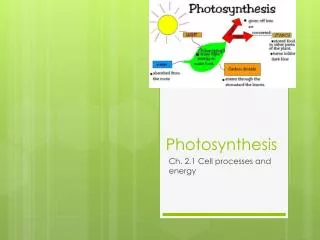
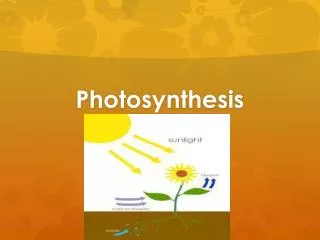
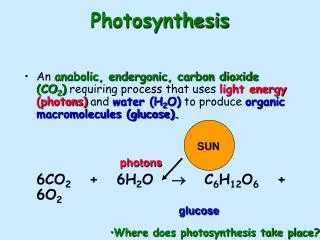
Photosynthesis • Energy from light is converted into energy of chemical bonds • Photosynthesis reduces carbon dioxide to three-carbon sugars and oxidizes water to oxygen
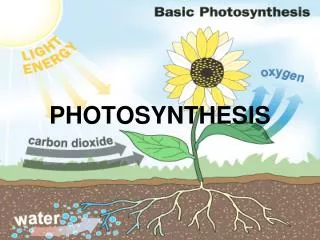
Photosynthesis • Reactants in the reaction are • Carbon dioxide gas(CO₂) • Water (H₂O) • The products from the reaction are • Oxygen (O₂) • Sugar molecule (C₆H₁₂O₆, glucose, carbohydrate) • Reactants are found on the left and the Products on the right
Photosynthesis- Aquatic Plants • During photosynthesis for aquatic plants as the plant uses more carbon dioxide in the water the water around the plant becomes less acidic
Light and Photosynthesis affect CO₂ Levels • Light is necessary for photosynthesis • In the presence of light, CO₂ levels decreased in water that contains aquatic plants • This indicates that CO₂ is used in the process of photosynthesis
Light and Photosynthesis affect O₂ Levels • Light is necessary for photosynthesis • In the presence of light, O₂ levels increase in water containing aquatic plants • This indicates that O₂ is a product of Photosynthesis
Investigation Three Photosynthesis
Photosynthesis -Products Sugar O₂ (Oxygen) Other living organisms use O₂ ti live and breath • Plants use the Chemical bond energy of the Sugars as an energy source • They use the energy to live and grow • Other organisms will eat the plants and they use the energy in the same way- to live and grow
Photosynthesis- Light • Light from the SUN is needed for plants and other organisms to carry out the process • Without light photosynthesis cannot occur
Plant Structure • Two main structures • Stem • Leaf • The cells within these structures contain chloroplast that hold the green chlorophyll pigments that are needed for photosynthesis
Importance of Light • Without light O₂ and sugar are not produced
Parts of the Plants where Photosynthesis Occurs • Both structures contain chloroplasts; therefore, it occurs in both places • However, more chloroplasts can be found in the leaves indicating that more Photosynthesis occurs in the leaf of a plant
Investigation Four Photosynthesis
Photosynthesis Products • Sugars that are produced during Photosynthesis are not always used right away • The plants will store the sugars in the form of starch so that the chemical bond energy is not wasted • Starch is a long chain of individual sugar molecules that are banded together • When the plant needs energy the sugar molecules are released from the starch • Starch is stored in the leaves where photosynthesis takes place
Photosynthesis Location and Pigments • Photosynthesis takes place in the chloroplasts where the chlorophyll is located • The chlorophyll contains the green pigment that is needed for photosynthesis