Understanding Projectile Motion: Key Principles and Calculations
This guide delves into the fundamentals of projectile motion, first described by Galileo. It explains the concepts of projectiles, trajectories, range, and height, while emphasizing the assumption of no air resistance. Key equations based on constant acceleration are provided, demonstrating how to analyze horizontal and vertical motion separately. Practical examples illustrate projectile motion scenarios - from objects launched horizontally to those at angles. Learn how to calculate velocity, height, and time of travel, making complex concepts accessible.

Understanding Projectile Motion: Key Principles and Calculations
E N D
Presentation Transcript
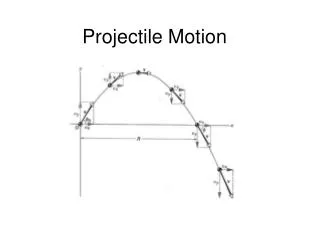
Basic Facts • First described by Galileo • Description made by analyzing horizontal and vertical components separately • Assumes NO AIR RESISTANCE!
Definitions • Projectiles: objects launched • Trajectory: the path that projectiles follow • Range: the maximum horizontal displacement • Height: the maximum vertical displacement
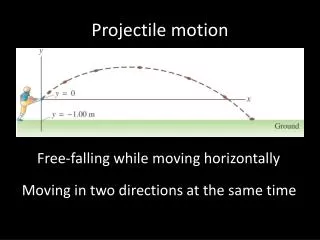
Facts about Projectiles • Horizontal velocity is constant • Vxi = Vxf • Use the big four equations from constant acceleration (use a = g in vertical case) • An object projected horizontally will reach the ground in the same time as an object dropped vertically
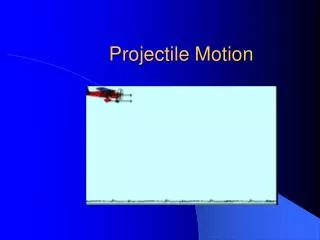
Projectiles Launched Horizontally • A rock is thrown horizontally from a 100.0 m high cliff. It strikes level ground 90.0 m from the base of the cliff. At what speed was the rock thrown? • Sketch • Identify your knowns and unknowns • Pick your equations and modify • Solve
Projectiles Launched at an Angle • Height occurs at ½ time • Angle of launch should be incorporated into equations
Sample #2 • A football is kicked at an angle of 37 degrees with a velocity of 20.0 m/s. Calculate: the height, the time of travel before it hits the ground, how far away it hits the ground, the velocity vector at the height, and the acceleration vector at the height. Assume for simplicity that the ball leaves the foot at ground level.