Understanding Density: The Science of Floating and Sinking
280 likes | 390 Vues
Explore the concept of density, a measure of how much matter occupies a certain volume. Density is defined as the ratio of mass to volume, revealing how many particles are packed into a space. Learn how to measure mass with a triple beam balance and volume using a ruler or graduated cylinder. Discover why objects float or sink in water based on their density compared to that of water (1 g/mL). Understand the role of density in Earth’s processes, ocean currents, and even the construction of boats, as well as how temperature affects density, impacting phenomena like warm air rising.


Understanding Density: The Science of Floating and Sinking
E N D
Presentation Transcript
What is density? Density is a ratio of how muchmatter there is in a certain amount of space. A measure of how many particles are packed into a certain area.
More dense = more particles in a space Less dense = less particles in a space
How do I find density? • I need to find out how much stuff (mass) is in a certain amount of space (volume)
What instruments do I need? • To find the mass of an object • Triple Beam Balance • Units are g • To find the volume of the object • Ruler or graduated cylinder • Units are cm3 or mL
How do I calculate density? Density = mass OR mass ÷ volume. volume Units for density: g or g cm3 m l ALWAYS REMEMBER UNITS!
Does the sample size affect the density of an object? • In other words, if I break off a piece of this cube, will it have a different density than the whole piece? • NO!!!
Density is based on total mass divided by total volume. • When one changes, the other also changes, so the density (which is a ratio) stays the same!!!
Which one is more dense? Which table group is most dense in the classroom? How about this: Which square is more dense?
Density of Water • Water has a density of 1g/mL • If an object has a density greater than 1g/mL, it will sink in water • If an object has a density of less than 1g/mL, it will float in water.
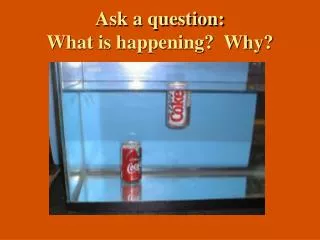
What do we know about the density of diet coke vs. coke vs. water?
Do liquids have different densities? • Yes! So what happens when you mix them? • They form layers with the highest density falling to the bottom. • Alcohol = .80 g/ml • Vegetable Oil = .90 g/ml • Water = 1.0 g/ml • Salt Water = 1.2 g/ml
The density of the liquid affects how you float too! • Denser liquids help you float more easily. • That is why it is easier to float in the ocean, than in a freshwater lake.
Metals have different densities • Lead 11.3 g/cm3 • Aluminum 2.7 g/cm3 • These are all over 1.0 g/ml and most ships are made of metal. So how do boats float?
Explain why one bowling ball floats and one sinks http://www.youtube.com/watch?v=NqNGW0oOXE4
Density helps move melted rocks under Earth’s crust • Hot material rises, cooler material sinks, creating a current, called a Convection Current crust mantle core
Solid Land has different densities • Continental Plates – lighter, thicker, made of granite • Oceanic Plates – heavier, thinner, made of basalt
Convergent Boundary • Plates move toward each other The more dense oceanic plate subducts under the less dense continental plate
Normal and Low bone densities • Low density bones break more easily.
Temperature can affect density • Remember. . . Warm air rises. • So this means warm air is less dense than cold air and it rises