Exploring Cosmic Evolution: Insights into Supernovae, Black Holes, and Instrument Development
This document outlines the science case for investigating the lifecycle of matter through the study of supernovae and the evolution of galaxy clusters to redshift z=2. It emphasizes the need for a second cryogenic instrument optimized for low energy to improve energy resolution and cut-off standards. Key areas of focus include the birth and growth of supermassive black holes (z~10), gravity in strong field limits, and extreme matter conditions near neutron stars. The roadmap includes the development of a prototype instrument and collaboration with international space agencies.

Exploring Cosmic Evolution: Insights into Supernovae, Black Holes, and Instrument Development
E N D
Presentation Transcript
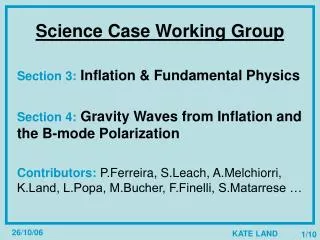
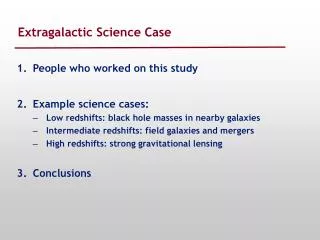
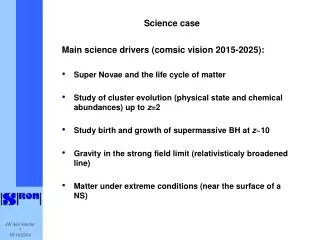
Science case Main science drivers (comsic vision 2015-2025): • Super Novae and the life cycle of matter • Study of cluster evolution (physical state and chemical abundances) up to z=2 • Study birth and growth of supermassive BH at z~10 • Gravity in the strong field limit (relativisticaly broadened line) • Matter under extreme conditions (near the surface of a NS) JW den Herder 1 18/10/2004
JW den Herder 2 18/10/2004
Conclusions • Science case Need for 2nd cryogenic instrument optimized at low energies, energy resolution prime driver, then low energy cutoff (0.2-0.1), next countrate, and finally FoV Redundancy is also an important driver • Instrument development plan Demonstrate capability to build cryogenic instrument for XEUS/Con-X in Europe Concentrate on TES microcalorimeter (but not excluding others) JW den Herder 3 18/10/2004
commonalities JW den Herder 4 18/10/2004
Prototype instrument requirements(not yet XEUS level)optimize on energy resolution JW den Herder 5 18/10/2004
Instrument concept JW den Herder 6 18/10/2004
Roadmap 1 JW den Herder 7 18/10/2004
Roadmap 2 JW den Herder 8 18/10/2004
Key issues for XEUS JW den Herder 9 18/10/2004
Next steps • Science case: justification for 2nd instrument optimized at low energy Bleeker, Barcons Compare to gratings, low E cut-off, Astro-E2, Be realistic, use cosmic vision • Prototype instrument development plan de Korte + others • High level system overview, technology risks and desired/required qualification level + technology risks • Face-to-face meetings (where appropriate) • Funding (seek funding at national level) • Explore potential Japanese interest (ISAS) • Coordinate developments with ESA (payload definition document etc) • Identify consequences of magnetic micro calorimeter in the prototype • Next meeting (spring 2005) • Coordination/progress monitoring den Herder JW den Herder 10 18/10/2004