Understanding Precipitation, Acid/Base, and Redox Reactions
110 likes | 241 Vues
Explore fundamental concepts of chemistry through precipitation, acid/base, and redox reactions. Learn solubility rules, including the solubility of various salts, alongside the dynamics of strong and weak acids and bases under the Brønsted-Lowry theory. Delve into the formation of phantom molecules, anhydrides, and hydrolysis reactions, and understand the vital roles of Lewis acids and bases. Lastly, grasp the principles of redox reactions, including elemental forms and the relevance of ions in solution. This guide offers a comprehensive overview for chemistry enthusiasts.


Understanding Precipitation, Acid/Base, and Redox Reactions
E N D
Presentation Transcript
1 - Precipitation Reactions - Solubility Rules - All salts containing _____ are soluble • Na+, K+, NH4+ (Cation Rule) • NO3-, C2H3O2-, ClO3- and ClO4- • Halides, except Group I (Ag+, Pb2+, Hg22+) • Sulfates, except Group I, Ba2+ and Sr2+ • Everything else is insoluble - The Exception
2 – Acid/Base Reactions • Strong Acids/Weak Acids • Strong Bases/Weak Bases • BrØnsted-Lowry Patterns • SA/SB • SA/WB • WA/SB • WA/WB • Phantom Molecules • Anhydrides • Hydrolysis • Lewis Acid/Bases
Strong Acids and Bases • Strong Acids … (Brown-LeMay) • HCl, HI, HBr • H2SO4 (first ionization) • HNO3 • HClO3 • HClO4 • Strong Bases … (Brown-LeMay) • LiOH • NaOH • KOH • RbOH • CsOH • Ca(OH)2 • Ba(OH)2 • Sr(OH)2
BrØnsted-Lowry Patterns • Strong Acid + Strong Base • H3O+ + OH- H-OH + H20 • Strong Acid + Weak Base • H3O+ + BOH H-OH + H20 +B- • Weak Acid + Strong Base • HA + OH- H-OH + A- • Weak Acid + Weak Base • HA + BOH H-OH + BA
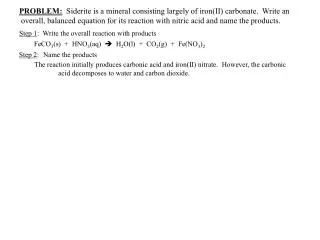
Phantom Molecules‘Unstable Products’ • H2SO3 H2O + SO2 • H2CO3 H2O + CO2 • NH4OH H2O + NH3
Anhydrides • Acidic Anhydrides • Oxides of a Nonmetal • SO2 + H2O H2SO3 • Basic Anhydride • Oxides of a Metal • CaO + H2O Ca(OH)2 • Acid Anhydride + Base Anhydride • Salt • CaO + SO3 CaSO4 • Add Heat to … CaO + SO3 CaSO4 • Reverses the Reaction
Hydrolysis • NaCl + H2O … • Na+ + Cl- + H2O Na+ + OH- +H+ +Cl- • H2O H+ + OH- • NaF + H2O … • F- + H2O HF + OH- • NH4+ + H2O … • NH4+ + H20 H30+ + NH3 • NH4C2H3O2 + H2O … • NH4C2H3O2 + H2O NH4OH + HC2H3O2
Lewis Acids/Bases • BF3 + NH3 • Lewis Diagram … F H F B :N H F H • BF3 + NH3 F3B-NH3 • Complex Ions • Double the cation charge (except Al – use 4) • Cu2+ + NH3 [Cu(NH3)4]2+
3 – Redox Reactions • Elemental Forms • 2 … H2, N2, O2, F2, Cl2, Br2, and I2 • ‘Horses Need Oats For Clean Brown Iyes’ • 3 … O3 • 4 … P4 and As4 • 8 … S8 • Ions in Solution • Combustion • Electrolysis • Fused Salt • Ions