Resistance and Tolerance of C. beticola to Fungicides in Sugarbeet Fields of Minnesota and North Dakota
This study investigates the resistance and tolerance of *C. beticola*, a significant pathogen in sugarbeet cultivation, to various fungicides including triphenyltin hydroxide (TPTH) and thiophanate methyl (TM). Data were collected from sugarbeet fields in Minnesota and North Dakota in 2000, revealing critical insights into the percentages of *C. beticola* populations exhibiting tolerance or resistance to these fungicides over time. The findings underscore the need for ongoing monitoring and management strategies to combat the emergence of resistant fungal populations in agricultural settings.

Resistance and Tolerance of C. beticola to Fungicides in Sugarbeet Fields of Minnesota and North Dakota
E N D
Presentation Transcript
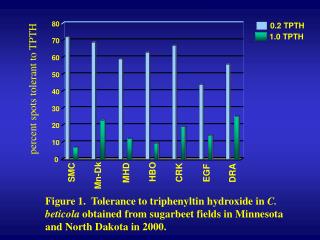
0.2 TPTH 80 1.0 TPTH 70 60 50 percent spots tolerant to TPTH 40 30 20 10 0 HBO EGF CRK SMC DRA MHD Mn-Dk Figure 1. Tolerance to triphenyltin hydroxide in C. beticola obtained from sugarbeet fields in Minnesota and North Dakota in 2000.
5.0 TM 60 50 40 percent spots resistant to TM 30 20 10 0 HBO EGF CRK SMC DRA MHD Mn-Dk Figure 2. Resistance to thiophanate methyl in C. beticola obtained from sugarbeet fields in Minnesota and North Dakota in 2000.
100 tetraconazole-amended PDA 90 1 ppm 80 2 ppm 70 3 ppm 60 4 ppm percent inhibition of radial growth 50 40 30 20 10 0 1479-5 1451-2 1481-5 1454-5 C. beticola isolate Figure 3. Tolerance to tetraconazole in C. beticola obtained from sugarbeet fields in Minnesota and North Dakota.
60 50 40 0.2 TPTH percent spots tolerant to fungicide 30 1.0 TPTH 5.0 TM 20 10 0 8-11-00 8-31-00 9-21-00 1 2 3 Sampling Date Figure 4. Tolerance to TPTH and TM in C. beticola obtained from sugarbeet fields in Minnesota and North Dakota as a function of sampling date.