SOLUTIONS
This guide delves into the properties and components of solutions, emphasizing the differences between solute and solvent. It covers essential concepts such as concentrated vs. dilute solutions, the "like dissolves like" rule for polar and nonpolar substances, and the distinctions between electrolytes and nonelectrolytes. Additionally, it explores the immiscibility of different solutions and factors that affect the dissolving rate. Lastly, it introduces solubility, equilibrium concepts, and the nature of alloys, providing a comprehensive overview for students and chemistry enthusiasts.


SOLUTIONS
E N D
Presentation Transcript
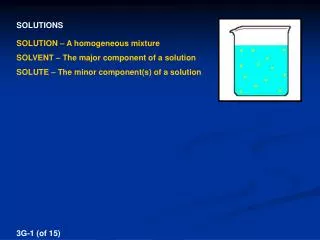
Solutions • Are homogeneous mixtures (look the same throughout) • Are PHYSICALLY combined • See p. 401
2 Parts of a Solution: solute solvent • Substance being dissolved • Usually present in the least amount • Ex: salt • Substance that is dissolving something else • Present in most amount • Ex: water (“universal solvent”)
CONCENTRATED DILUTE • More solute than solvent • More solvent than solute
THE DISSOLVING RULE: “LIKE DISSOLVES LIKE” Water is a polar molecule: Polar solutes dissolve well in polar solvents Ex: salt water Nonpolar solutes dissolve well in nonpolar solvents
See p. 406 Electrolytes Nonelectrolytes • Solutions that conduct electricity • Ex: salt water • Solutions that do not conduct electricity • Ex: sugar water
IMMISCIBLE miscible • Do not dissolve well in each other • Ex: water & oil, oil & vinegar • Dissolve well in each other • Ex: water & sprite
Ways to Increase Dissolving Rate • Stir • Powder/crush up the solute (this increases its surface area) • Increase pressure (this is Henry’s Law—if pressure increases, solubility increases) • Increase heat (this is NOT true for gases dissolved in liquids) see p. 414 top graph
EQUILIBRIUM • When 2 opposing changes take place at the same time at the same rate • Ex: unopened coke can (see p. 408)
WHAT HAPPENS WHEN YOU OPEN THE COKE CAN????? • Effervescence----the rapid escape of a gas from its solution • Le Chatlier’s principle---when a system is stressed, a new equilibrium will be reached at new conditions (coke can will become flat when left opened)
ALLOYS • Solutions of metals • Created to increase strength and to resist corrosion • Ex: brass, bronze, sterling silver, pewter, stainless steel, gold jewelry
SOLUBILITY—how much solute will dissolve in a certain amount of solvent at a given temp & pressure • See p. 414 solubility curves • SATURATED—has max. amt. of solute ---is a point on the line UNSATURATED—has less than the max. solute --is a point below the line SUPERSATURATED—has over the max. solute ----is a point above the line ---temp & pressure have to be raised
Terms sheet • 1---3, 5---14, 24---25 (NOTES) • Define: 4, 15---23
ACTIVATOR—WORD SPLASH • List as many words or phrases that come to mind when you hear the word “solutions”.