Understanding Solar and Lunar Eclipses: A Guide by Doug Horacek
180 likes | 306 Vues
Join Doug Horacek, resident astronomer at the Von Braun Astronomical Society, as he explores the fascinating world of eclipses. Learn how solar eclipses occur only during a new moon when the Moon is aligned perfectly with the Earth and Sun. Discover the difference between total and annular solar eclipses, and understand the key moments of totality. Additionally, delve into lunar eclipses, including the spectacular total lunar eclipse and its captivating red hue. Gain insight into the different types of eclipses and their visibility.


Understanding Solar and Lunar Eclipses: A Guide by Doug Horacek
E N D
Presentation Transcript
Astronomy Day4 October 2014Eclipses By Doug Horacek Resident Astronomer Von Braun Astronomical Society
Solar Eclipses • Solar Eclipses only happen at New Moon • Total Solar Eclipses only happen when the Moon is closer to Earth and at New Moon • Annular Solar Eclipses happen when the Moon is further from Earth and at New Moon • Total and Annular Solar Eclipses Can only be seen along a narrow band of the Earth.
Total Solar Eclipses The Details related to Total Solar Eclipses
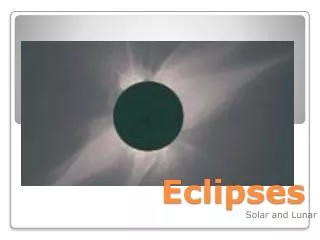
Events During Total Solar Eclipse • First Contact when the umbra of the Moon’s shadow first touches the Sun. • Second Contact when the first Baily’s Bead occurs just before Totality. • Totality, last for a relatively short amount of time. • Third Contact marked by the second Baily’s Bead at the end of Totality. • Fourth Contact when the umbra of the Moon’s shadow last touches the Sun.
Duration of the FullTotal Solar Eclipse • From First Contact to Fourth Contact usually takes Several Hours. • Totality Last Generally a matter of minutes.
Appearance of TotalityFor Sunspot Maximum and Sunspot Minimum Sunspot Minimum Sunspot Maximum
Total Lunar Eclipse • A Total Lunar Eclipse happens when the Full Moon moves behind the Earth’s Shadow. • A Total Lunar Eclipse may last as long as an hour or a little longer or less depending on how it crosses the Earth’s Shadow. • The intensity of the red may vary depending on how it crosses the Earth’s Shadow. • A Total Lunar Eclipse may be seen by as much as a whole continent, a much broader area than a Solar Eclipse.
Types of Solar Eclipses • Penumbral • Partial • Annular (Antumbral) • Total
Types of Lunar Eclipses • Penumbral • Partial • Total
Celestial Awareness PoemFor October Lunar Eclipse Sight of the Red Moon Earth Casting its Red Shadow Splendor of the Sky