Dynamic Biomaterials with Light-Triggered Adhesion Motifs for Enhanced Cell Interactions
20 likes | 150 Vues
Our research focuses on engineering biomaterials that feature cell-adhesive motifs triggered by external stimuli, specifically light. By manipulating the presentation of adhesive ligands, we aim to optimize cell-material interactions. We have developed hydrogels that incorporate a caged-RGD peptide, which is activated by 351 nm light, exposing the adhesive peptide within minutes. This platform facilitates the study of high-resolution spatiotemporal control over cell adhesion. Our project supports graduate research and promotes diversity through the recruitment of underrepresented undergraduate students.


Dynamic Biomaterials with Light-Triggered Adhesion Motifs for Enhanced Cell Interactions
E N D
Presentation Transcript
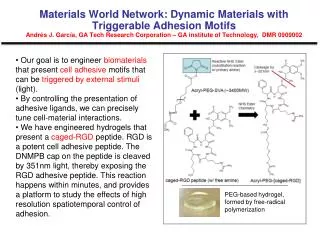
Materials World Network: Dynamic Materials with Triggerable Adhesion MotifsAndrés J. García, GA Tech Research Corporation – GA institute of Technology, DMR 0909002 • Our goal is to engineer biomaterials that present cell adhesive motifs that can be triggered by external stimuli (light). • By controlling the presentation of adhesive ligands, we can precisely tune cell-material interactions. • We have engineered hydrogels that present a caged-RGD peptide. RGD is a potent cell adhesive peptide. The DNMPB cap on the peptide is cleaved by 351nm light, thereby exposing the RGD adhesive peptide. This reaction happens within minutes, and provides a platform to study the effects of high resolution spatiotemporal control of adhesion. PEG-based hydrogel, formed by free-radical polymerization
Materials World Network: Dynamic Materials with Triggerable Adhesion MotifsAndrés J. García, GA Tech Research Corporation – GA institute of Technology, DMR 0909002 • Project has supported a graduate bioengineering student. • Graduate student and PI will visit collaborator at the Max Planck Institute for Polymers in Germany to conduct experiments as part of MWN award. • We are recruiting an underr-epresented minority undergraduate student for a summer project. Cell adhesion to biomaterials can be triggered by light. Hydrogels with caged-peptide that are not exposed to light support background levels of adhesion. In contrast, exposure to light for 2 min, activates RGD peptide and provides robust adhesion.