Exploring Hydrogen Production Technologies
Introduction: <br>In the race towards a sustainable future, hydrogen has shown great promise as a substitute energy source. It is a leader in solving energy and environmental issues due to its adaptability, abundance, and promise for zero-emission applications. An essential component of realizing the potential of hydrogen is developing sustainable and effective manufacturing techniques. This article examines several hydrogen production technologies, emphasizing their foundational ideas, benefits, and drawbacks.<br>

Exploring Hydrogen Production Technologies
E N D
Presentation Transcript
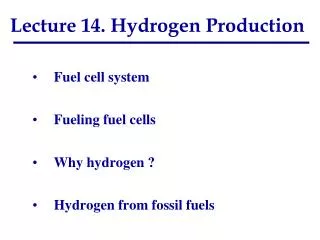
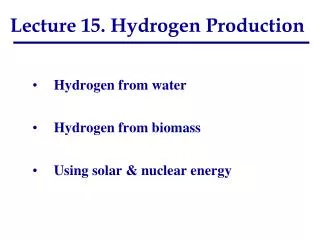
Exploring Hydrogen Production Technologies Introduction: In the race towards a sustainable future, hydrogen has shown great promise as a substitute energy source. It is a leader in solving energy and environmental issues due to its adaptability, abundance, and promise for zero-emission applications. An essential component of realizing the potential of hydrogen is developing sustainable and effective manufacturing techniques. This article examines several hydrogen production technologies, emphasizing their foundational ideas, benefits, and drawbacks. DOWNLOAD PDF BROCHURE- https://bit.ly/42kiBLT 1.Steam Methane Reforming (SMR): Principle: SMR involves reacting methane (CH4) with steam (H2O) at high temperatures (700-1100°C) and pressures to produce hydrogen and carbon monoxide. • Advantages: Widely practiced due to the abundance of natural gas, cost- effectiveness, and maturity of the technology. • Challenges: Carbon dioxide (CO2) is produced as a byproduct, contributing to greenhouse gas emissions unless carbon capture and storage (CCS) technologies are implemented. • 2.Electrolysis: Principle: Electrolysis splits water (H2O) into hydrogen (H2) and oxygen (O2) using electricity. Two primary methods include alkaline electrolysis (AE) and proton exchange membrane electrolysis (PEM). • Advantages: Offers a pathway for producing hydrogen using renewable energy sources like wind and solar, enabling emissions-free production. • Challenges: High electricity consumption, infrastructure requirements, and cost barriers need to be addressed for widespread adoption. • 3.Biomass Gasification: Principle: Biomass gasification involves thermochemically converting organic materials into a syngas composed of hydrogen, carbon monoxide, and other gases. • Advantages: Utilizes organic waste streams, offering carbon-neutral or even carbon- negative hydrogen production. • Challenges: Efficiency improvements, feedstock availability, and managing impurities in the syngas are areas of focus for commercial viability. • 4.Photoelectrochemical (PEC) Water Splitting:
Principle: PEC utilizes semiconductor materials to absorb sunlight and directly split water molecules into hydrogen and oxygen. • Advantages: Holds promise for efficient solar-driven hydrogen production without the need for external electricity sources. • Challenges: Limited material stability, low conversion efficiencies, and scalability issues hinder large-scale deployment. • 5.High-Temperature Water Splitting (Thermochemical): Principle: Thermochemical water splitting involves using high temperatures and chemical reactions to produce hydrogen from water, often utilizing metal oxides as catalysts. • Advantages: Potential for high efficiency and compatibility with concentrating solar power (CSP) systems. • Challenges: Complex reactor designs, material degradation at high temperatures, and optimization of reaction kinetics are ongoing research areas. • Conclusion: Hydrogen production technologies play a pivotal role in realizing the full potential of hydrogen as a clean energy carrier. Each method offers unique advantages and faces distinct challenges, highlighting the need for continued research, innovation, and collaboration across sectors. As efforts intensify to decarbonize energy systems and combat climate change, advancing sustainable hydrogen production technologies will be crucial for a greener and more resilient future. By embracing diverse approaches and leveraging advancements in science and engineering, we can pave the way for a hydrogen economy that fosters prosperity while safeguarding the planet for generations to come. READ MORE- https://www.marketsandmarkets.com/industry-practice/hydrogen/hydrogen- technologies-comparison