Understanding the Respiratory System: Breathing Mechanics and Gas Exchange
This agenda covers vital aspects of the respiratory system, focusing on gas exchange and the mechanics of breathing. The lessons include insights into how oxygen enters the blood and how carbon dioxide is expelled. Students will learn about the diaphragm's role and the interaction of rib muscles during breathing. The session also addresses the physiological changes during exercise and the importance of breathing in voice production. Engaging prompts will encourage reflection on the mechanics of breathing and lung functionality.

Understanding the Respiratory System: Breathing Mechanics and Gas Exchange
E N D
Presentation Transcript
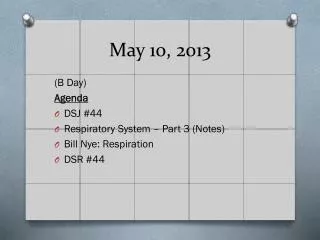
May 10, 2013 (B Day) Agenda • DSJ #44 • Respiratory System – Part 3 (Notes) • Bill Nye: Respiration • DSR #44
May 13, 2013 (A Day) Agenda • DSJ #44 • Respiratory System – Part 3 (Notes) • Bill Nye: Respiration • DSR #44
DSJ #44 • Science Notebook – 22B • Prompt: Describe the kind of breaths we take when we are exercising. Why must our breathing be this way? Explain in 5 sentences or more.
Learning Objective • Describe what happens during gas exchange and breathing.
Gas Exchange • 23. After air enters an alveolus, oxygen passes through the wall of the alveolus into the blood. Carbon dioxide and water pass from the blood into the alveoli.
Gas Exchange • 24. Your lungs can absorb a large amount of oxygen because of the large surface area of the alveoli.
Gas Exchange • An adult’s lungs contain about 300 million alveoli. If you opened the alveoli and spread them out on a flat surface, you would have a surface area of about 70 square meters, which is the size of a large hotel room.
How You Breathe • 25. The rate at which you breathe depends on your body’s need for oxygen. The more oxygen you need, the faster you breathe.
How You Breathe • 26. The diaphragm is a large, dome-shaped muscle that plays an important role in breathing. Diaphragm
How You Breathe Air rushes into the chest, and you inhale. The rib muscles and diaphragm relax, and the chest cavity becomes smaller. The air is squeezed out of the lungs, and you exhale. The pressure of the air inside the lungs decreases. • 27. • Rib muscles and diaphragm contract, making the chest cavity larger.
Breathing and Speaking • 28. Another name for the voice box is the larynx.
Breathing and Speaking • 29. Vocal cords, are folds of connective tissue that produce your voice.
Breathing and Speaking • 30. Two vocal cords stretch across the opening of the larynx. Air moving over the vocal cords causes them to vibrate and produce sound.
Glue in SNB **Please remember to use only TWO drops of glue!!** If everyone uses only TWO drops, a lot of glue is saved over time…. • 21A – Respiratory System – Part 2 & 3 • 23B – Bill Nye: Respiration
DSR #44 • Science Notebook – 22B (Under DSJ #44) • Prompt: What gives lungs the ability to absorb a large amount of oxygen? Which muscle is responsible for breathing? How are we able to speak?