Galaxies
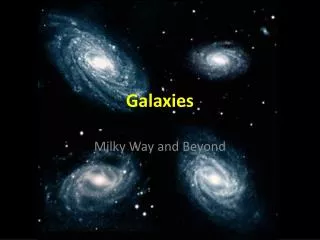
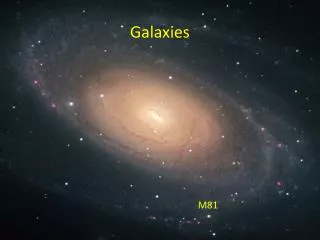
This chapter delves into the fascinating realm of galaxies, showcasing the diverse shapes, sizes, and structures in the universe. We discuss types of galaxies such as spirals, ellipticals, and irregulars, including barred spiral variations. The dynamics of galaxy interactions, including galactic cannibalism, highlight how smaller galaxies can merge with larger ones. Additionally, we examine the role of supermassive black holes at galaxy centers and introduce key concepts like the Hubble Law for distance measurement and "look-back times" to understand the vastness of our universe.

Galaxies
E N D
Presentation Transcript
Galaxies Chapter 16
Galaxies • Star systems like our _______ _____ • Contain a few __________to tens of _______of stars. • Large variety of shapes and sizes
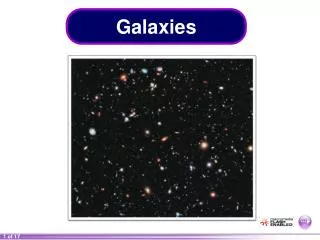
Galaxy Diversity Even seemingly __________regions of the sky contain __________of very _____, very distant __________ : The Hubble Deep Field: 10-day exposure on an apparently empty field in the sky
Galaxy Classification E0, …, E7 Sa Large _________; tightly wound ________ E0 = _________ E1 Sb Sc Small ________; loosely wound __________ E7 = Highly ____________ E6
Gas and Dust in Galaxies Spirals are rich in ______and _______ Ellipticals are almost devoid of ____and ___ Galaxies with disk and bulge, but no dust are termed ______
Barred Spirals • Some spirals show a pronounced ______structure in the center • They are termed _________spiral galaxies • Sequence: • ____, …, ______, • analogous to regular spirals
Irregular Galaxies Often: result of galaxy _________/ ___________ Often: Very active star ___________(“Starburst galaxies”) The Cocoon Galaxy NGC 4038/4039 Some: Small (“dwarf galaxies”) satellites of larger galaxies (e.g., Magellanic Clouds) Large Magellanic Cloud
Distance Measurements to Other Galaxies (2): The Hubble Law E. Hubble (1913): Distant galaxies are moving _________from our Milky Way, with a recession velocity, vr, proportional to their distance d: vr = H0*d H0≈ 70 km/s/Mpc is the Hubble constant • Measure vr through the __________effect infer the _____________
The Extragalactic Distance Scale • Many galaxies are typically millions or billions of _______________from our galaxy. • Typical distance units: • Mpc = ______________= 1 million __________ • Gpc = ______________= 1 billion __________ • Distances of Mpc or even Gpc The light we see left the galaxy _______or __________of years ago!! • “Look-back times” of _______or _______of years
Supermassive Black Holes From the measurement of stellar _________near the center of a galaxy: Infer mass in the very center ______black holes! Several million, up to more than a billion ______ __________! Supermassive black holes
Our Galaxy Cluster: The Local Group Milky Way Andromeda galaxy Small Magellanic Cloud Large Magellanic Cloud
Galactic Cannibalism • Collisions of large with small galaxies often result in complete _______of the _______galaxy. • ______galaxy is “swallowed” by the ______one. NGC 5194 • This process is called “galactic cannibalism”